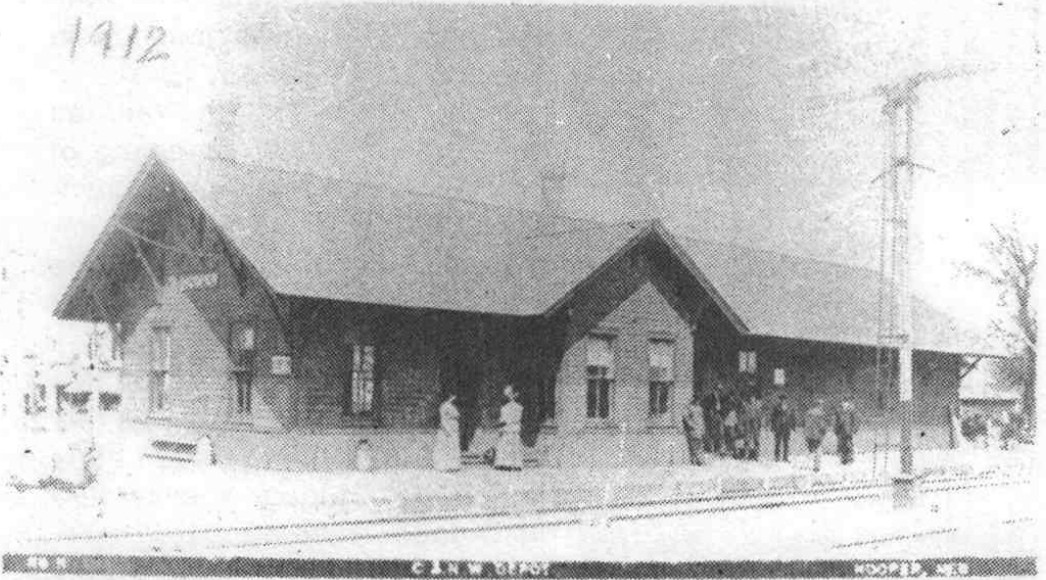
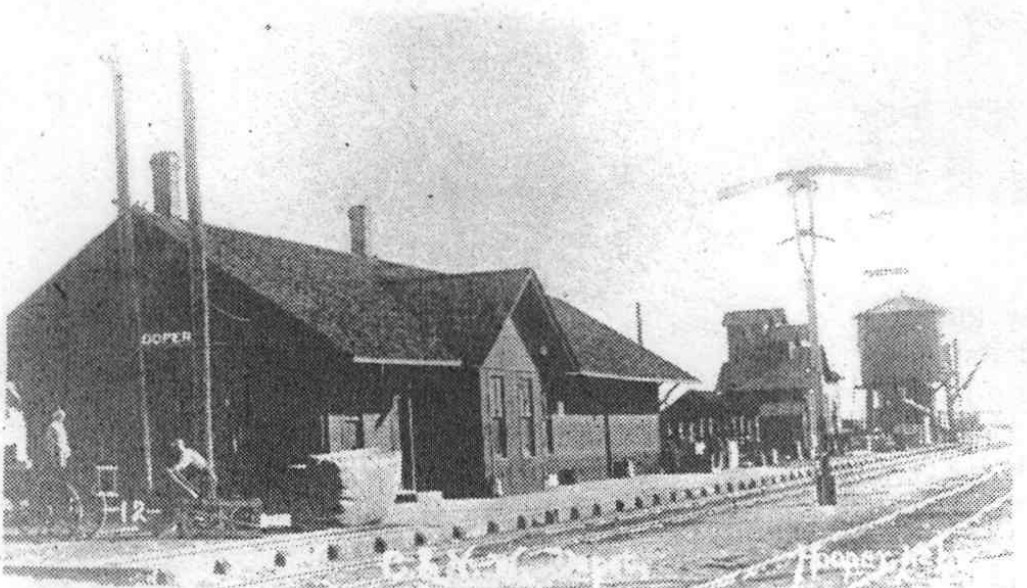
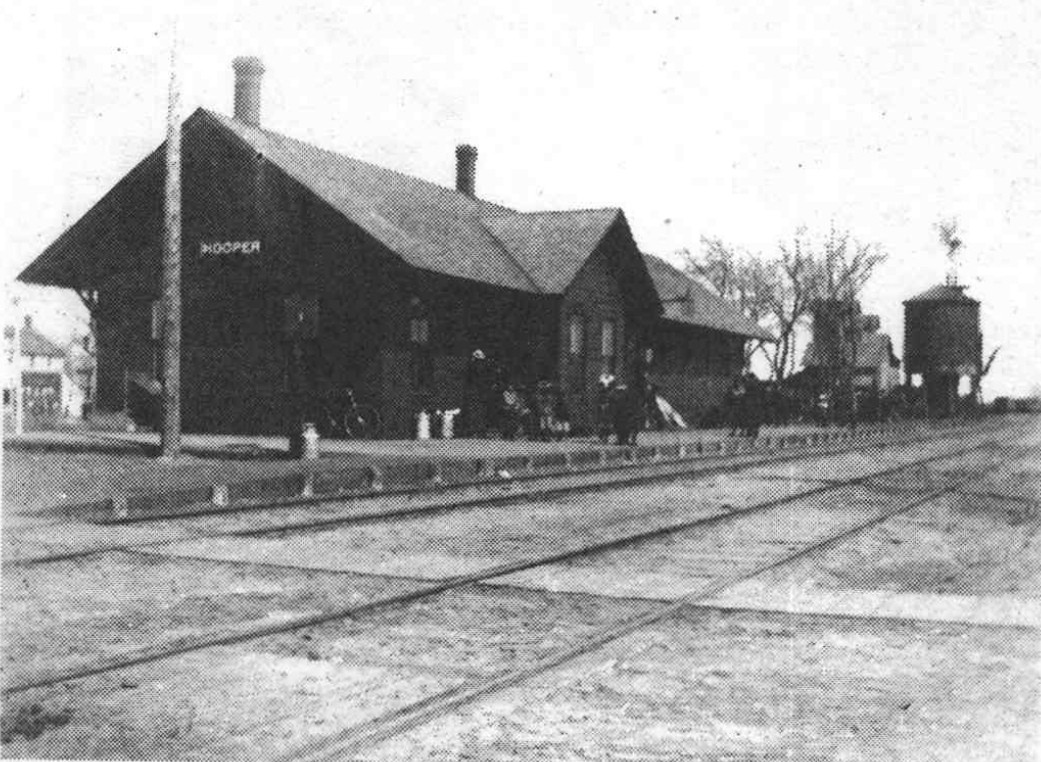
Hooper’s railroad depot once stood across the highway and just east of the Hooper Inn. People waited on its platform, freight moved through the adjoining tracks, and a water tank helped supply the steam locomotives. The building has been gone since 1967, but photographs preserve a place that connected Hooper’s farms, businesses and families with communities far beyond the Elkhorn Valley. [1]
The depot was part of a working system. A farmer’s livestock, a merchant’s shipment, an excursion ticket and a message sent by telegraph all depended on people keeping that system moving. Hooper’s 1976 centennial history, together with contemporary issues of the Hooper Sentinel, lets us follow the station from its early combined duties to a new building in 1899, a busy commercial era and eventual demolition.
A town organized around the railroad
The centennial history places the railroad at the center of Hooper’s beginnings. Its railway account describes the townsite being laid out on land purchased from the Sutton family. Asa Briggs, the first agent named in that account, also operated a store and post office in the depot. The same building therefore served several everyday needs while the settlement developed around it. [1]
Those duties help explain why the station mattered even to someone who rarely bought a passenger ticket. The depot was a place to receive goods and news, conduct business and meet arriving travelers. Telegraph service added another connection. The book names J. W. Briggs as a later agent whose responsibilities included telegraphy, the post office and townsite business. [1]
Railroad names changed over the life of the station. The centennial history describes Hooper’s connection with the Fremont, Elkhorn and Missouri Valley, and later with the Chicago & North Western. The depot photographs preserve that later North Western setting. These are successive parts of Hooper’s railroad history. The broader story of the town’s settlement and plat is covered in When Was Hooper Founded? [1][4]
1899: building a new depot while the trains kept coming
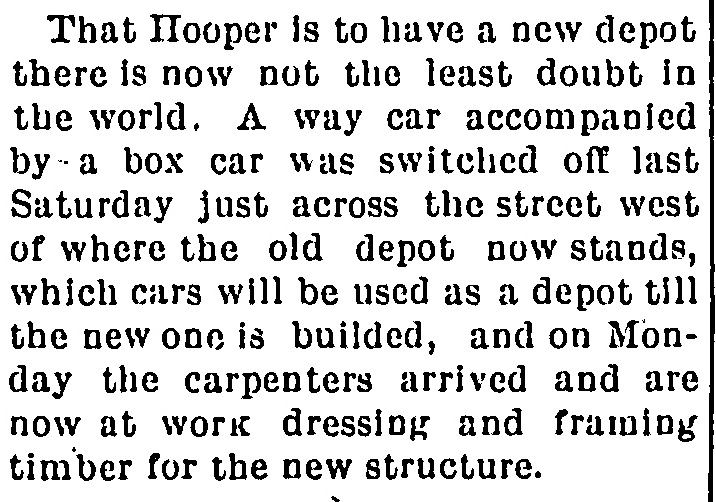
The old station did not stop being needed while its replacement was under construction. On September 28, 1899, the Sentinel reported that a way car and a boxcar had been placed across the street west of the existing depot. They would serve as temporary quarters while carpenters prepared and framed the new structure. It was a practical way to keep station business going during the building work. [2]
By December, the work was nearing its end. The December 7 Sentinel expected the new depot to be ready for occupancy that Saturday or early the following week. The centennial history dates its completion to December 1899. Together, the reports establish an autumn construction project followed by a new station at the close of the year. [1][3]
The photographs show the building that became familiar to later generations: a substantial depot with several rooflines, windows facing the tracks and a long platform. One postcard is reproduced in the centennial book with a handwritten 1912 date. Another view reveals the platform’s relationship to the nearby railroad structures. These images preserve both the public face of the station and the working space around it. [1]
Tickets, excursions and the timetable
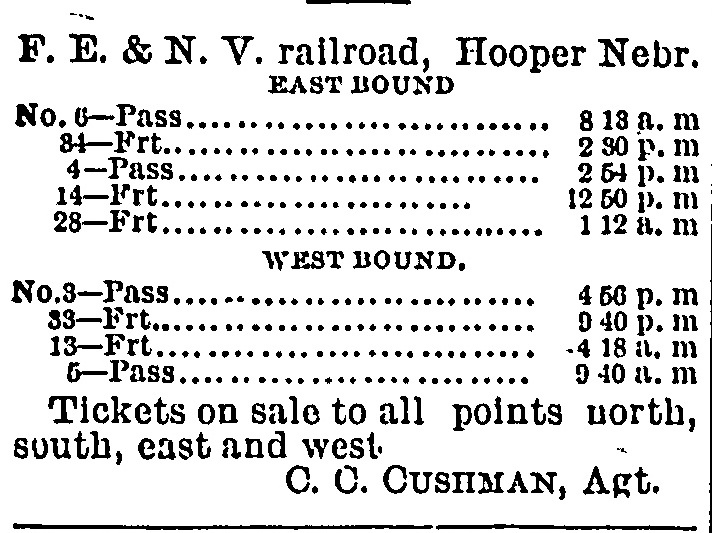
For residents planning a trip, the newspaper timetable was useful household information. The June 15, 1899 issue lists eastbound and westbound services, distinguishing passenger trains from freight trains, and names C. C. Cushman as Hooper’s agent. The same page announced excursion trains from Omaha and intermediate stations to Norfolk for the Orphans’ Home Festival on June 25. The notice advertised a $2 round-trip fare, with Hooper’s departure at 8:04 in the morning and tickets available at the depot beforehand. [4]
The railway also brought large gatherings into town. The centennial history recounts an October 1896 political celebration attended by visitors on a special train from Fremont. It describes a procession, bands and two meetings, one conducted in English and the other in German. The station linked Hooper to regional political life as well as to markets and family visits. [1]
In 1926, a much shorter stop drew a crowd. According to the book, between fifty and seventy-five people gathered when Vice President Charles G. Dawes and General John J. Pershing passed through on a trip to Cherry County. The two men appeared on the rear platform of their private car and offered brief greetings. For the people waiting in Hooper, an ordinary railway platform briefly became a place to see national figures. [1]
What moved through Hooper
Passenger photographs can make a depot look primarily like a place for journeys. Hooper’s freight figures reveal another side. A station-business account from the 1914 Sentinel, reproduced in the centennial history, lists hundreds of inbound and outbound carloads. Building materials and fuel came in; agricultural products and locally manufactured bricks went out. [1]
| Direction | Cargo | Carloads |
|---|---|---|
| Received | Lumber | 400 |
| Received | Coal | 150 |
| Received | Automobiles | 30 |
| Forwarded | Brick | 530 |
| Forwarded | Livestock | 225 |
| Forwarded | Grain | 250 |
These are counts of railway carloads, not tons or individual items. The automobile entry is especially revealing: the new machines that would change local transportation initially arrived as railroad freight. Hooper’s garages and dealers depended on the same railway that carried lumber for construction and coal for heating. The outbound brick total connects the station with Hooper’s brickmaking industry. [1]
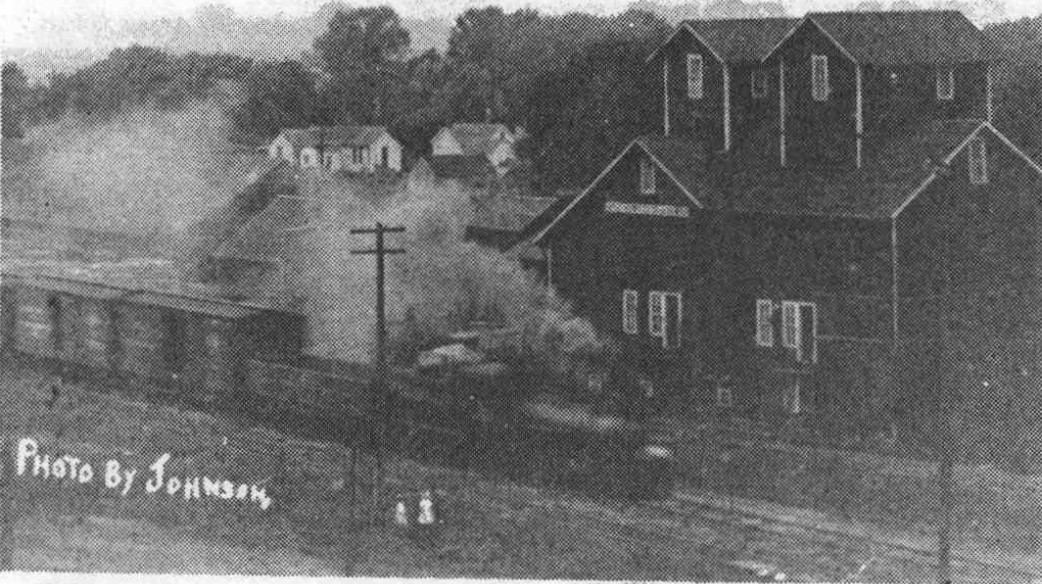
A photograph of a train passing the Farmers Grain and Stock Company shows how closely railway and agricultural business occupied the same landscape. The elevator stands immediately beside the tracks. Hooper’s commercial importance extended beyond what someone could see in Main Street’s storefront windows: grain, livestock and other heavy shipments moved through the rail corridor. [1]
The people and work behind a train’s arrival
A timetable named the agent, but keeping trains moving involved more people. The centennial account names day telegrapher Roy Hasselquist and night telegrapher O. Himebaugh. It also recalls a crew of sixty men sent to Hooper in November 1897 to install switches and sidetracks. The station’s usefulness depended on this less visible work as much as on the building itself. [1]
C. C. Cushman became one of the familiar figures of that working world. The book records his arrival in Hooper in 1894 and retirement in 1928 after thirty-four years as ticket agent. It also notes his part-time greenhouse business. The newspaper timetable supplies a contemporary connection between that name and the station: Cushman is already identified as the agent in June 1899. [1][4]
Weather could interrupt the schedule. The June 15, 1899 Sentinel described stormwater washing mud, tin cans and other debris onto the railroad from the hill. Crews had to clear the obstruction, and trains were delayed. Rail travel connected the town to distant places, but it still depended on conditions immediately around Hooper. [4]
Derailments and changing equipment
In August 1928, five loaded grain cars left the rails near the depot as an eastbound freight entered a siding for a westbound passenger train. The centennial history describes roughly three hundred feet of damaged roadbed, a blocked crossing and a detour for road traffic. A crew came from Scribner, and a wrecking outfit was sent from Missouri Valley. By about four that afternoon, the cars were back on the rails. None had overturned, and the account reports no loss of grain. [1]
It was a reminder that a railway incident affected the whole town: the obstruction disrupted both train movements and the street crossing. The depot was where those different forms of travel met.
Equipment changed as well. The centennial history records a 1933 authorization for the Chicago & North Western to substitute gas-electric motors for steam engines on passenger trains 11 and 22 between Omaha and Norfolk. Hooper’s station history therefore spans more than the familiar era of smoke and steam preserved in its early photographs. [1]
1967: taking down the depot
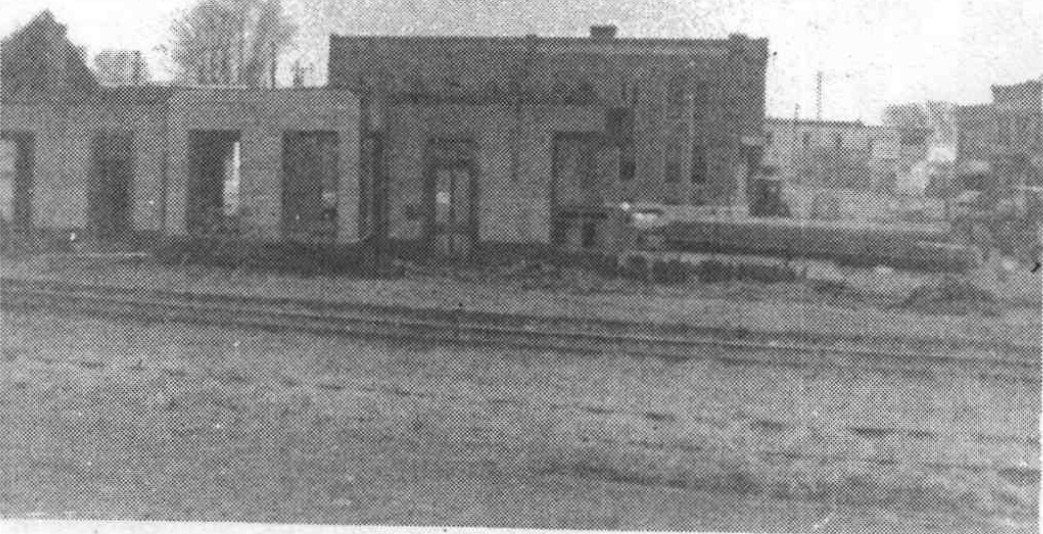
The centennial book preserves two photographs of the depot’s demolition, both explicitly dated 1967. In the first, the roof is gone and portions of the walls remain. In the second, most of the structure has disappeared, leaving its floor and foundation exposed. The accompanying account says some of the lumber was purchased by area farmers and reused for sheds and other purposes. [1]
Those photographs make the loss concrete. The depot was removed in stages, and some of its materials took on new uses elsewhere. Its disappearance changed the appearance of the railway grounds, but it did not by itself mark the end of every later railroad activity on the Fremont–Hooper corridor. [1][5]

A corridor with a later chapter
The state’s 2014 railroad history identifies the later seventeen-mile Fremont–Hooper route with the Fremont & Elkhorn Valley Railroad. That later operation belongs to a different chapter from the nineteenth-century depot and its 1967 demolition. [5]
By February 2025, Fremont’s planning documents described a new use for the abandoned rail corridor. An engineering scope proposed a 2.8-mile paved trail segment within Fremont, from the existing trail system near Somers Street toward Luther Road, and stated an aspiration to extend a trail along the full seventeen-mile route to Hooper. That document establishes a plan and a longer-term goal; it does not establish that a complete trail to Hooper had opened. [6]
The old photographs remain the clearest view of the depot itself: the people by the platform, the freight spaces, the water tank and, finally, the dismantled building. Together with the newspaper notices, they preserve a landmark whose daily work helped Hooper function.
More Hooper stories
- When Hooper Took to the Road: Monnich, Tunberg & Reetz and Smida Garage
- Inside the Harms Store: A Family and Nearly Eighty Years of Hooper Shopping
- When Hooper Went to the Show: Tilson’s Opera House and the Amusu Theatre
- The Hooper Sentinel: The People Who Put a Town in Print
- Hooper’s Post Office: The People Who Carried the Mail