
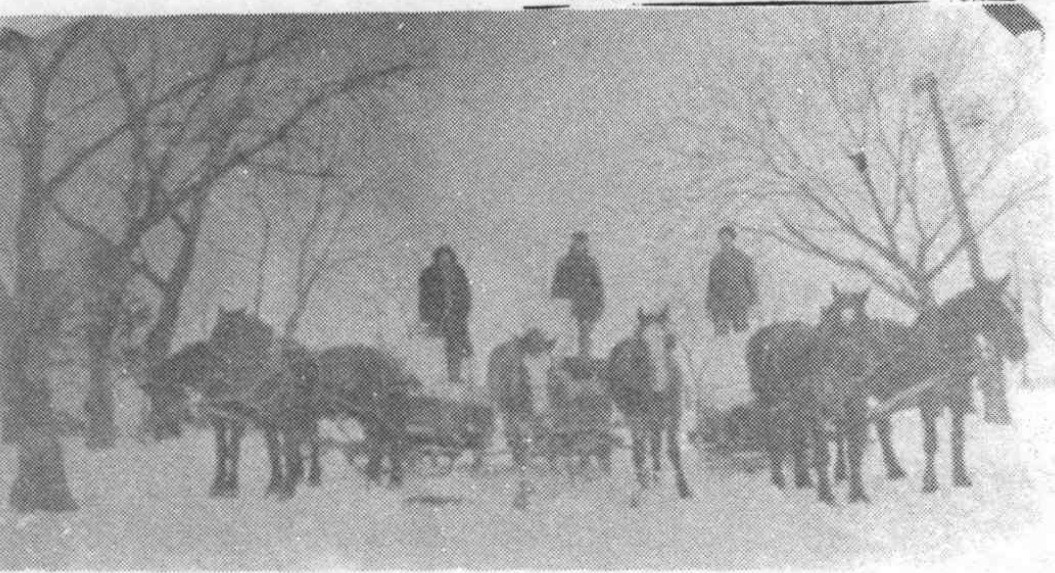
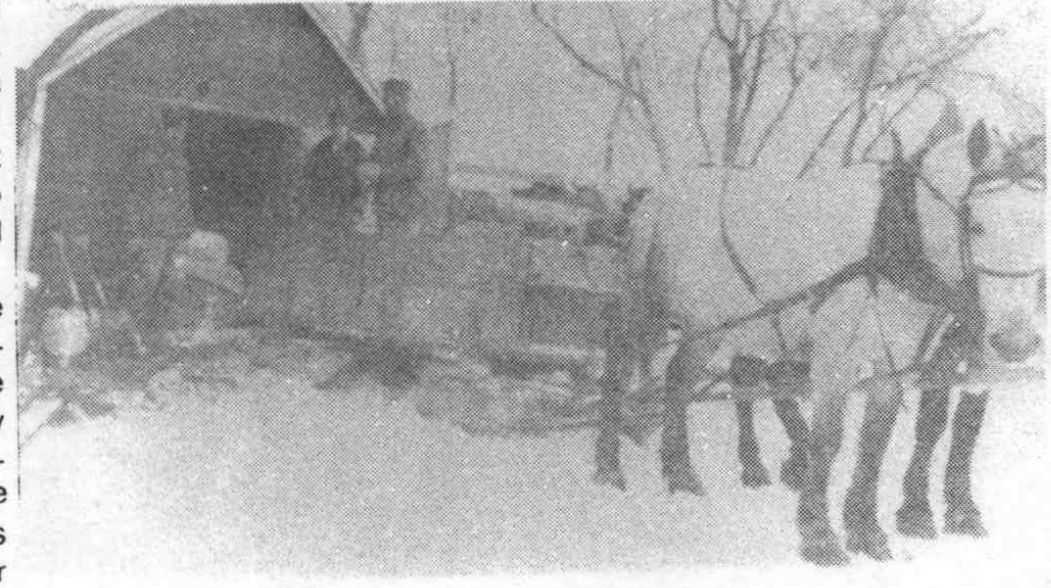
In one of Hooper’s old photographs, employees stand with horse teams and loads of ice. In another, horses wait outside the ice company’s headquarters in December 1914. These were the people, animals and buildings behind a service that depended on winter work to meet summer demand.[1]
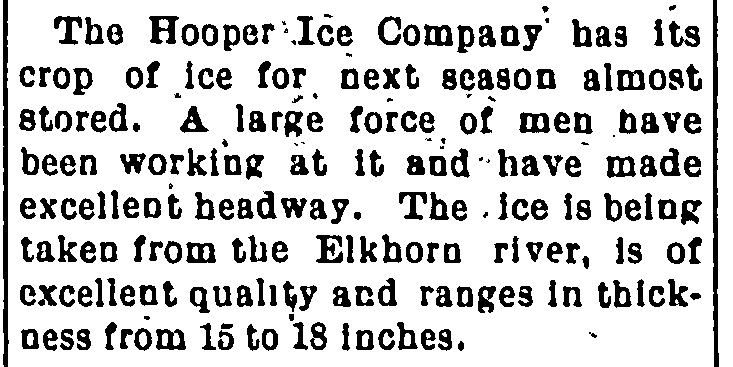
A January 1909 newspaper item brings that work into focus. A large Hooper Ice Company crew was nearly finished putting away the season’s supply. The ice came from the Elkhorn River and measured 15 to 18 inches thick. The paper judged the harvest favorably and reported that the crew had made good progress.[4]
Before the company: ice at Stroh’s market
Hooper’s ice trade was already established before the company photographs were taken. A January 1901 Hooper Sentinel profile of Adolph Stroh’s meat market described a business supplying ice during the summer, with two icehouses and a delivery wagon. Stroh’s customers therefore knew an ice service alongside his trade in meat.[2]
The centennial history dates Stroh’s entry into the meat business to 1889 and describes a shop selling fresh cuts, smoked meats, sausages and other provisions. His portrait belongs with the ice story because the newspaper directly connects his business to the town’s supply. It also shows how refrigeration was a practical concern within a familiar Main Street trade.[1][2]

The later Hooper Ice Company appears in the centennial history with an entry for January 18, 1906, when construction of an icehouse north of town began. By 1908, contemporary newspaper coverage shows an organized company with stockholders, directors and accounts to review.[1][3]
A company meeting with a dusty-street problem
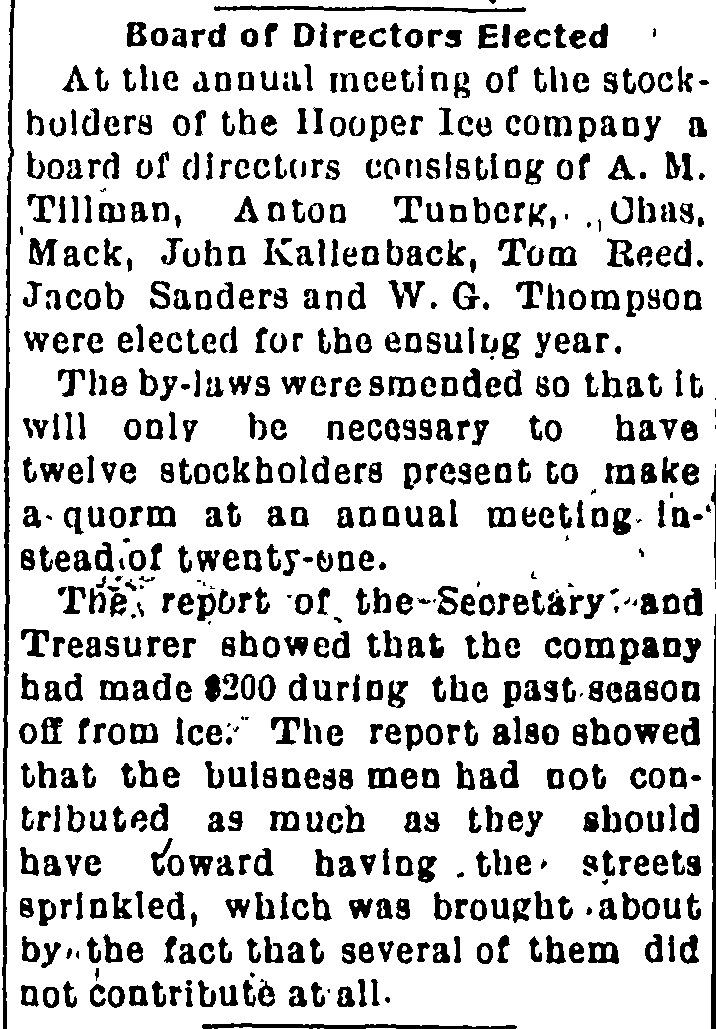
At its 1908 annual meeting, stockholders elected A. M. Tillman, Anton Tunberg, Charles Mack, John Kallenback, Thomas Reed, Jacob Sanders and W. G. Thompson to the board. They also reduced the number of stockholders needed for a meeting quorum from twenty-one to twelve. The secretary and treasurer reported about $200 earned from ice during the past season.[3]
One problem had little to do with keeping anything cold. The company was also involved in sprinkling Hooper’s streets. The annual report said business houses had not contributed enough to cover that work, with several contributing nothing. Ice delivery and street watering thus appear together in the same company accounts.[3]
The issue continued. The centennial history’s 1910 entry reports a seasonal profit of $364.65 and describes the street-sprinkling arrangement as voluntary monthly payments from business houses. Directors discussed alternatives but kept the existing system. The company was serving both its individual customers and a shared need along the business streets.[1]
Cutting and storing the Elkhorn’s winter ice
The January 21, 1909 newspaper report gives unusually specific evidence about the harvest itself: its river source, the size of the working crew and the ice’s thickness. Rather than a small delivery business acquiring a few blocks at a time, the company was assembling a stock large enough for the approaching season.[4]
The photographs preserve the delivery side of that operation. The teams-and-loads picture shows several workers together with horses and their cargo. The headquarters picture is dated December 22, 1914, in the book. Neither image supplies the workers’ names, but both show the scale of the transport and storage work behind a household delivery.[1]
1909: customers needed an ice book
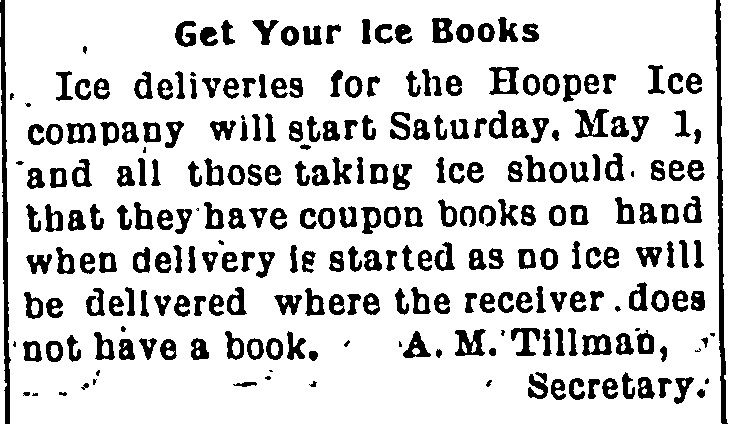
Customers had a specific task before deliveries began. A notice printed in the May 6, 1909 Sentinel advertised a May 1 start and told everyone taking ice to have coupon books ready. The company would deliver only where the recipient had a book. It was a straightforward operating rule, signed by A. M. Tillman as secretary.[5]
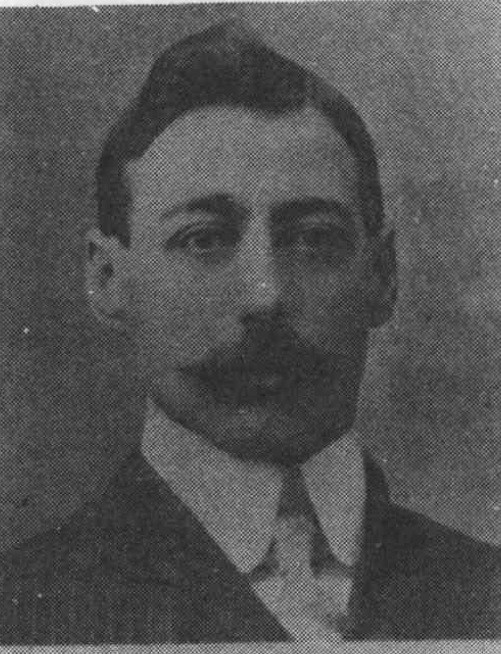
Tillman is also a familiar name in Hooper’s banking history. His portrait provides a connection between two kinds of local enterprise: a bank handling accounts and an ice company arranging seasonal service. In the ice notice, his role is explicit. He was the officer telling customers how to prepare for the delivery route.[1][5]
1919: when the stored supply ran low
A successful winter harvest did not remove the possibility of a summer shortage. In 1919, ice man Will Jeffers reported that the icehouse would reach its bottom layer by the middle of July. The centennial history says residential delivery would then stop until more ice could be brought from elsewhere.[1]
Norman E. Shaffer, then the company’s secretary, went to Fremont to see whether an additional supply could be arranged. That episode shows the limits of the local stockpile. When it ran down, continuing the service meant finding another source beyond Hooper and bringing the product back into town.[1]
1924–1926: new cooling equipment and an old icehouse
Stroh’s market returned to the refrigeration story in 1924, when it installed a Clinton system connected to its icebox and display case. The centennial history records the market’s satisfaction with the equipment and its claimed advantages in cleanliness and operating cost. The shop that had once supplied summer ice was adopting another way to keep its own goods cool.[1]
The ice company’s buildings still mattered after that installation. In November 1926, a windstorm lifted its recently relocated icehouse from the foundation and caused damage estimated at a couple of hundred dollars. The building had been moved to property near the baseball grounds.[1]
The surviving accounts capture the change through concrete events: a new refrigerator at a market, a damaged icehouse near the ballgrounds, and an earlier shortage that sent a company officer to Fremont. Beside them, the photographs preserve the crews and teams of the delivery years. Hooper’s cold supply was once a visible local business, with winter work on the river and summer customers waiting along its route.[1][4][5]