Hooper’s mill story begins beside Logan Creek, before the town’s railroad-era business district existed. A dam and sawmill established in 1859 grew into a place where farmers brought grain, travelers stayed and neighbors gathered. Later, the milling business moved into Hooper and became one of the town’s substantial industrial operations.[1]
The photographs show both settings: a compact mill beside the creek and a much larger collection of buildings at Hooper. Between those images lies a history of changing machinery, power sources, owners and markets. Flour remained central, but the mill’s work also reached into livestock feed, town water pumping and the daily trade between farms and stores.[1][2]
1859: a dam, a sawmill and the beginning of Logan Mills
According to the centennial history, Harvey J. Robinson and Dennis Dean built a dam on Logan Creek and put a sawmill into operation in 1859, then began constructing a gristmill. The account describes oak timbers, cottonwood framing and siding, and an oak-shingle roof. This was a building assembled from the materials and workmanship available in the early settlement years.[1]
A gristmill gave farmers somewhere to turn grain into flour or feed. The local history describes customers making long journeys and sometimes waiting days while their grain was processed. Such traffic created reasons for other services to collect around the mill. At Logan, the mill became the center of a small settlement as well as a place of production.[1]

The Briggs years: a place to trade and gather
A. C. and J. F. Briggs took over the mill interests during the 1860s. A post office was established at Logan in August 1864, and a blacksmith shop was added in 1867. A general store and expanded residential accommodation followed as the settlement developed. The centennial history identifies 1867 and 1868 as the years when Logan came closest to becoming a town.[1]
Supplies for the store were hauled from Omaha. Butter and eggs went out in barrels, with bran packed around the eggs for protection. The Briggs residence accommodated mill customers and became a gathering place for settlers from the Logan and Elkhorn valleys. The book describes frequent social use of the house, alongside the practical business of lodging people who were waiting at the mill.[1]
Maintaining water power required continued work. The history recalls neighbors helping to rebuild the dam and mill, sometimes walking several miles to the job. Floods, water conditions and the upkeep of the dam all formed part of the business. The mill’s setting supplied its power, but keeping that power usable took labor beyond the grinding room.[1]
From millstones to a roller process
A March 1887 Sentinel description, reprinted in the centennial book, opens a window into the machinery. It described a multistory mill filled with equipment for cleaning grain, breaking it down, separating middlings and sifting the resulting products. Rollers, purifiers, reels and elevators passed material through a sequence of operations.[1]
This was more elaborate than simply feeding grain between a single pair of stones. Different stages produced different grades of flour and byproducts, while other equipment handled feed and rye. The machinery account explains the later name “Roller Mills”: the process depended on repeated reductions and separations rather than one pass through the building.[1]
The move into Hooper
By the late 1880s, the milling business had moved into Hooper and adopted steam power. The centennial account describes a new building incorporating salvaged material and machinery from the earlier mill. Oswald Uehling became associated with Briggs in this phase of the business. An adjoining grain elevator was erected in 1889.[1]
The Hooper plant used an 80-horsepower steam engine to drive six sets of rollers. Its power also served a municipal purpose: under a five-year agreement, steam from Uehling’s boiler drove pumps for the village waterworks. The flour mill was therefore connected to the town’s water service as well as to its grain trade.[1]
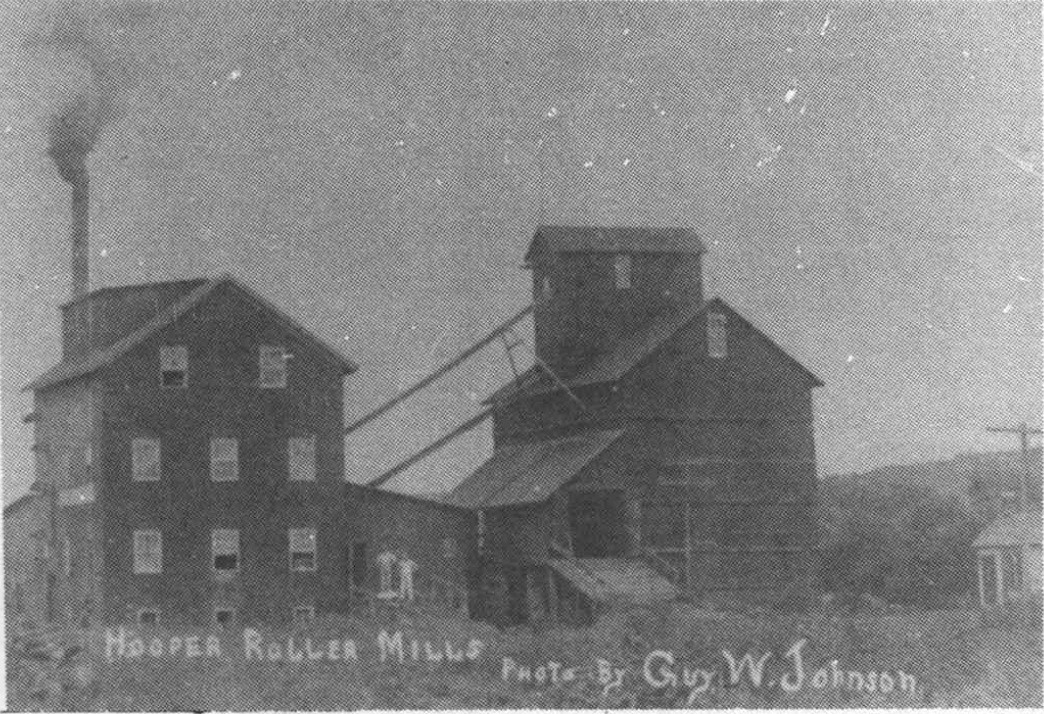
A March 18, 1897 entry in the local history identifies the Hooper Roller Milling Company as the corporation succeeding Oswald Uehling, with John M. Uehling, Henry Bayer and John Uehling named as its members. The new corporate name appears in the context of an established operation that continued to seek local farm and household business.[1]
1899: the mill makes its case to local customers
In October 1899, the proprietors took their argument directly to readers of the Hooper Sentinel. Their item, headed “From the Village Miller,” urged residents to buy local mill products. It described the mill as a purchaser of grain, a provider of custom grinding and an enterprise whose dealings brought farm customers into town.[2]

The appeal was a sales pitch, but its description of the trade is useful. The mill wanted farmers to sell and grind grain locally, and wanted households and merchants to buy the resulting products. Its business linked the farm gate, the mill and Hooper’s stores. The proprietors argued that supporting that circuit would benefit the town.[2]
A February 1900 review of the previous year’s business put a number beside the argument. After listing Hooper’s 1899 railroad freight, the newspaper added mill output because the greater part had been delivered by wagon. It reported company-book sales totaling 2,480,000 pounds of products. Hooper’s commercial reach extended beyond what appeared in the rail-shipment totals.[3]

New managers, new machinery and longer working hours
The early twentieth century brought further changes. Under F. W. King in 1910, the mill offered souvenir drinking cups and parlor thermometers with trade. That year, J. W. Gift of Peoria, Illinois, visited to examine the wheat-cleaning and conditioning equipment. The centennial history records his favorable assessment and says comparable equipment was obtained for Peoria.[1]
Ownership and management continued to change. The history records a stock company taking charge and overhauling the mill in 1916. By the wartime period and 1919, it used the name Hooper Milling and Grain Company. After continuous electric service became available in Hooper, the mill could operate by day and night to meet demand and government contracts.[1]
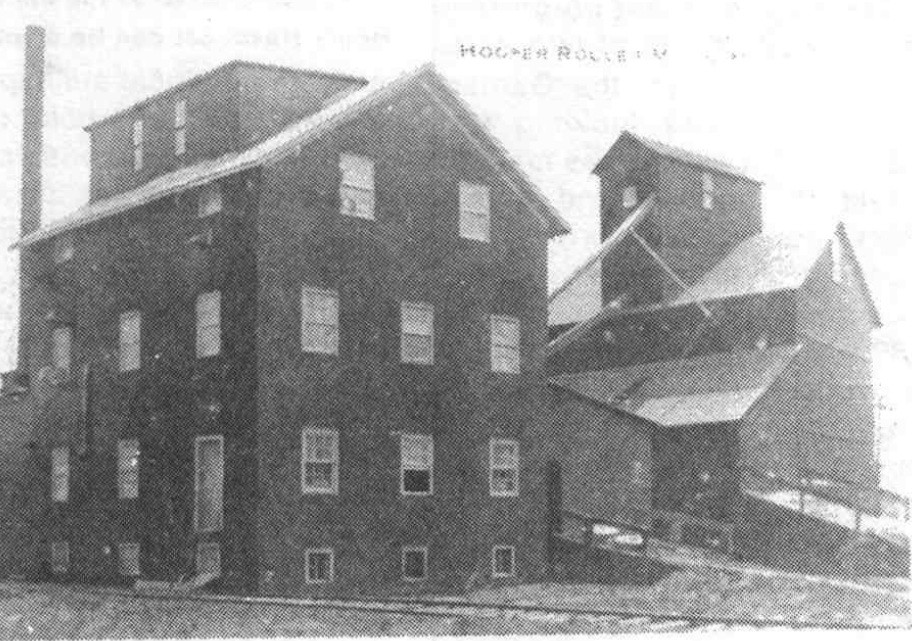
In 1924, J. B. and F. B. Rossiter, associated with Walthill and Winnebago, purchased the mill’s stock. W. F. Anderson and John Urban were to continue running the plant. The sale changed ownership while retaining the men involved in its daily operation.[1]
Remembering Logan while the mill’s later chapter closed
The original creek site was already being treated as a historic place by 1930. The September 25 Scribner Rustler announced a monument-unveiling program at the original Logan Mills site north and east of Hooper for October 2. That notice formed part of a wider effort to mark early Dodge County places.[4]
The Hooper property had one more recorded attempt at renewal. In 1931, D. H. Nellis of Early, Iowa, bought it with plans to reopen the mill. The centennial history describes that effort as short-lived. Its three photographs preserve different parts of a long working life: the creek mill that drew a settlement around it, the enlarged plant in Hooper and the close-up of the roller-mill buildings.[1]