
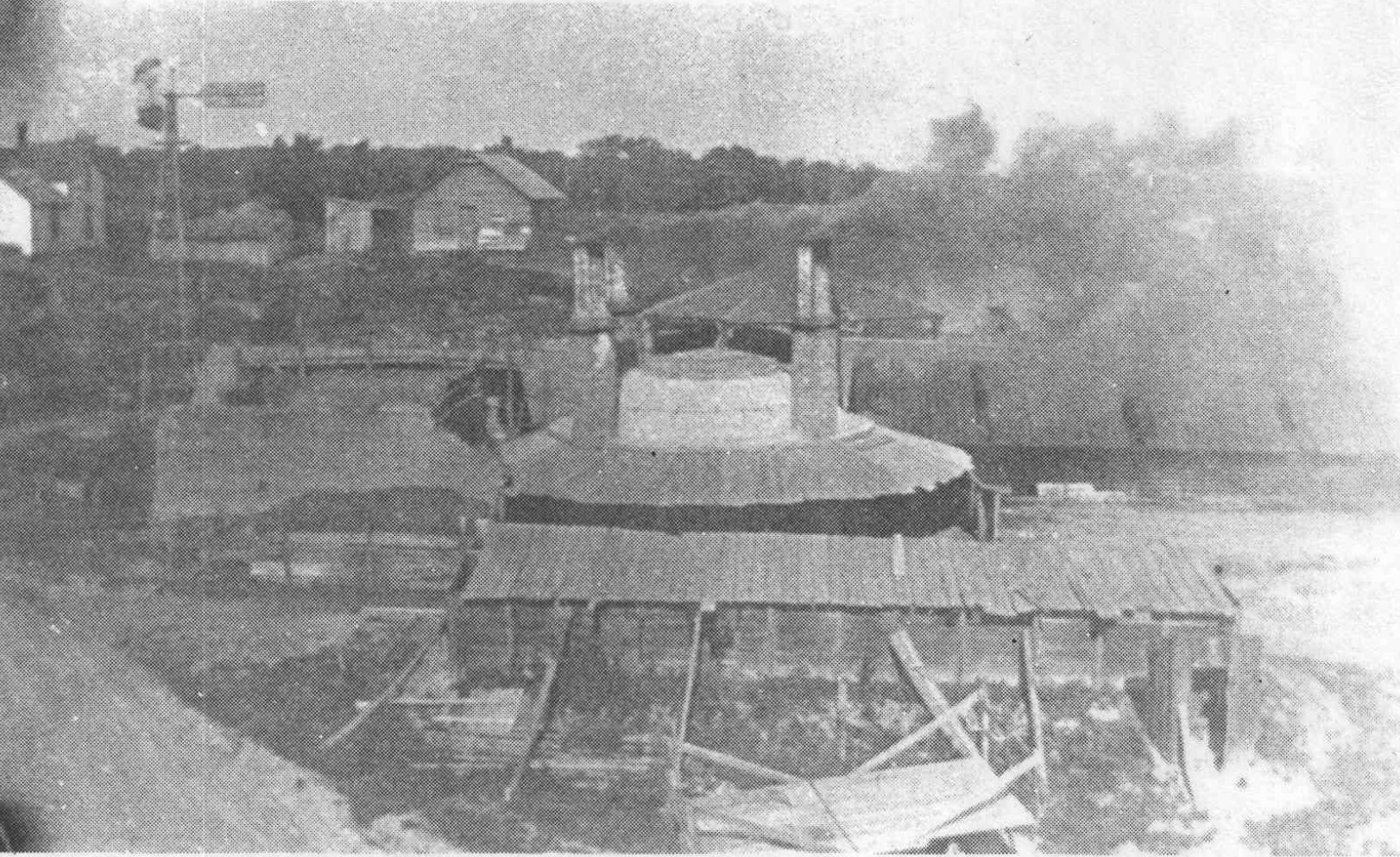
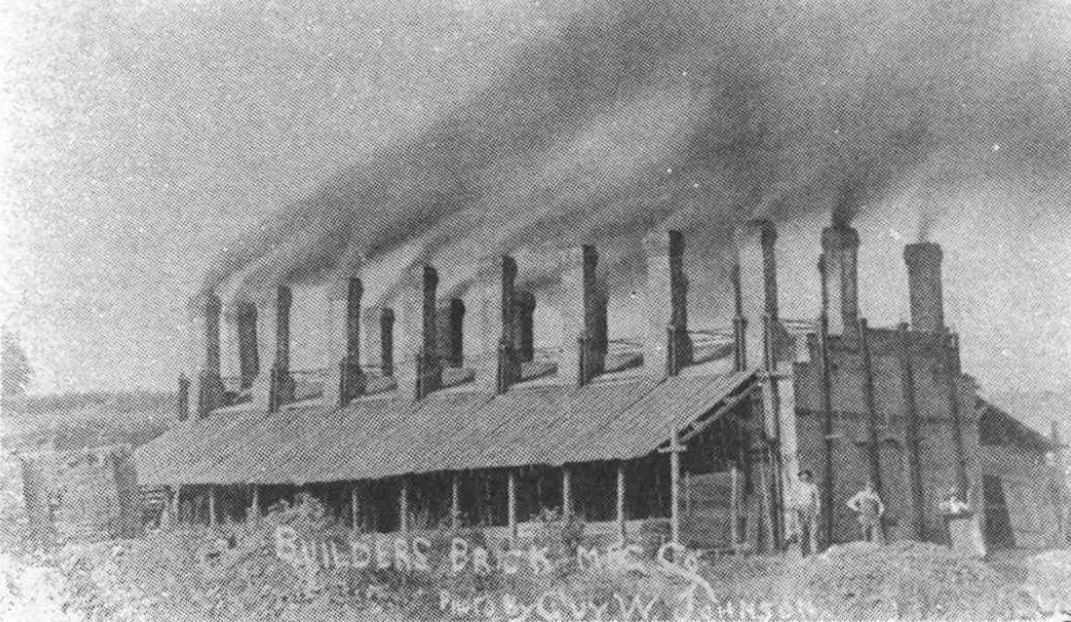
The name Brickyard Hill remembers work that has largely disappeared from view. Where the self-guided tour now points to a house and a residential subdivision, Hooper once had clay pits, drying sheds, kilns and a rail connection for shipping finished brick. The photographs preserve the workers as well as the buildings: men standing behind loaded carts, with the company’s name written across the picture.[1][2]
Two stops, two different pieces of the story
The Historical Committee’s tour identifies stop 7 as the Brickyard House at 1020 County Road 19 and dates it to 1876. Stop 8 is Brickyard Hill, at County Road 19 and the highway junction. The guide places the subdivision on the old brick-storage yard. The development’s own history makes that same connection, although the similar wording means the two accounts should not automatically be counted as independent confirmation.[1][6]
The house needs a more precise history. The tour does not name its builder, original owner or function in the business. It would be premature to call it a manager’s house, company office or workers’ residence. Its name and location provide a useful starting point; a deed chain, dated map or contemporary address record is still needed to establish those details.[1]
The businesses behind the brick
The 1976 centennial book brings together several accounts of Hooper brickmaking. One describes Carl Bayer and Sons beginning a yard in 1892 and later organizing a company with Theodore Kroeger, W. F. Basler and Bayer. Another describes John Edelmaier’s management and the involvement of Waterman and Baker. These passages should be read as accounts of changing businesses, rather than compressed into a single founding date for everything called the Hooper brickyard.[2]
Two short notices in the June 22, 1893 Sentinel provide contemporary evidence of a new yard in operation. Both are signed Charles Bayer, manager. They advertise brick ready for delivery and say the yard’s first kiln had opened that week. “New” describes the operation being advertised; it does not mean Hooper had never had a brickyard before. Nor do the notices identify the tour house’s role.[8]

A biography published in 1921 adds a regional connection. It describes Edelmaier working with Waterman near Fontanelle, moving the operation to Scribner in 1889, and buying John Heimrick’s Hooper yard with his partner in 1894. It reports a seasonal workforce of 35 to 40 men. Yet Waterman’s biography in the same volume gives 1893 for the Hooper purchase. The centennial compilation also uses 1893 for Edelmaier’s taking charge. The conflicting accounts do not establish one certain transaction date.[5][7][2]
Waterman’s profile describes expansion from four kilns to ten and a daily capacity of 50,000 bricks at the time of the account. It gives 157 acres for the plant and land together and lists shipments to Wyoming, South Dakota, Iowa and Nebraska. These are reported capacity and reach, not proof that the factory made that quantity every day.[7]
How a Hooper brick was made
The centennial book’s account of early-twentieth-century production describes a yard between two hills, where clay and nearby sand could be obtained. Workers hauled the clay in heavy two-wheeled carts, mixed it with sand and water, and left the mixture overnight. Horses powered the molding equipment. One worker controlled the mixture; another sanded the molds; others carried the newly formed bricks to drying sheds.[2]
Drying was only the beginning. After several days, the bricks were turned so their undersides could dry. The account says younger boys or girls sometimes did this work. Bricks were then loaded into a kiln with spaces between them to let heat circulate. A gentle initial firing drove out moisture, followed by days and nights of heavier coal firing. The writer estimated about eighteen days from raw material to finished brick when the sequence was not interrupted.[2]
Those details explain why the old photographs show so many people and carts. Brickmaking depended on repeated handling, judgment about moisture and heat, and work beyond ordinary daylight hours. The history also gives differing production figures for different accounts and periods; they should not be treated as one continuous daily output.[2]
A March 1934 obituary gives one worker a name. The Sentinel recalled that Albert Bayer arrived in Hooper as a child and helped in his father’s brick yard and pottery works as he grew up. It does not identify him in a surviving group photograph.[9]
A local product that traveled
The centennial history records orders from towns along the Fremont, Elkhorn and Missouri Valley line. By its account of 1914, the plant had railroad sidings beside the kilns and coal bins, employed 40 men in season, and had recorded $35,000 in sales during 1913. The siding connected heavy materials and a small-town workforce to customers beyond Hooper.[2]
One particularly useful outside reference identifies a customer. The National Register nomination for the Christopher Knoell Farmstead near Fremont says the family began hauling brick from Hooper in 1887 for a house built in 1888. That establishes a documented use of Hooper brick elsewhere in Dodge County. It does not identify the precise yard or prove that every brick building in Hooper used locally manufactured brick.[4]
Bayer’s clay business also produced flowerpots and hanging vases. The centennial account describes machinery installed in 1895 and sales to wholesalers and nurseries. Its reference to closing around 1925 or 1926 appears in the flowerpot discussion; it should not be used by itself to date the closure of every brickmaking operation in town.[2]
From industry to a neighborhood
In the 2026 anniversary book, Jeff Wacker describes the development of Brickyard Hill in 2007 on land acquired from the Hargens family. The Wackers saw a need for places to build homes while the four-lane highway was under construction. Roads and utilities preceded the first completed home, at 1014 Brickyard Drive, in 2008.[3]
This later chapter is part of the site’s history, too. The land changed from an industrial landscape to a place for housing, while the neighborhood’s name kept the earlier use visible. The anniversary account’s house and lot totals describe the book’s moment in time; they are not a current real-estate inventory.[3]
Why the stops belong in Hooper’s history
Our interpretation is that these two stops give visitors a way to connect the town’s brick architecture with the labor and landscape behind it. The industry’s history reaches from clay and coal to families, rail transport and regional construction. The later subdivision adds the story of a community making room for new homes. The committee did not separately document its selection rationale, so this explanation of significance is ours, based on the cited records.
Explore the database entries for the Brickyard House and Brickyard Hill, or read how fires changed downtown Hooper. Deeds, company ledgers, dated workers’ photographs and kiln-location maps could still help identify the house’s role and distinguish the successive brickmaking businesses. If you have material to contribute, please contact Celebrate Hooper.