
Hooper and the Flood of 1944 · Part 1 of 5
The alarm sounded twice that Sunday morning. The first, around six, followed a lightning strike at the Clarence Heywood home. The second, shortly after 7:30, carried a different warning: floodwater was moving toward Hooper. The Sentinel’s first account placed the approaching crest along the pavement and railroad tracks after flooding at Scribner. [A]
A warning carried door to door
Hooper’s fire department and civilian-defense auxiliary firemen went into the rain to warn residents. The newspaper describes them going from house to house through town and its outskirts, urging people to leave for higher ground to the south. Telephones were one part of the emergency; people walking the streets and shouting warnings were another. [A]
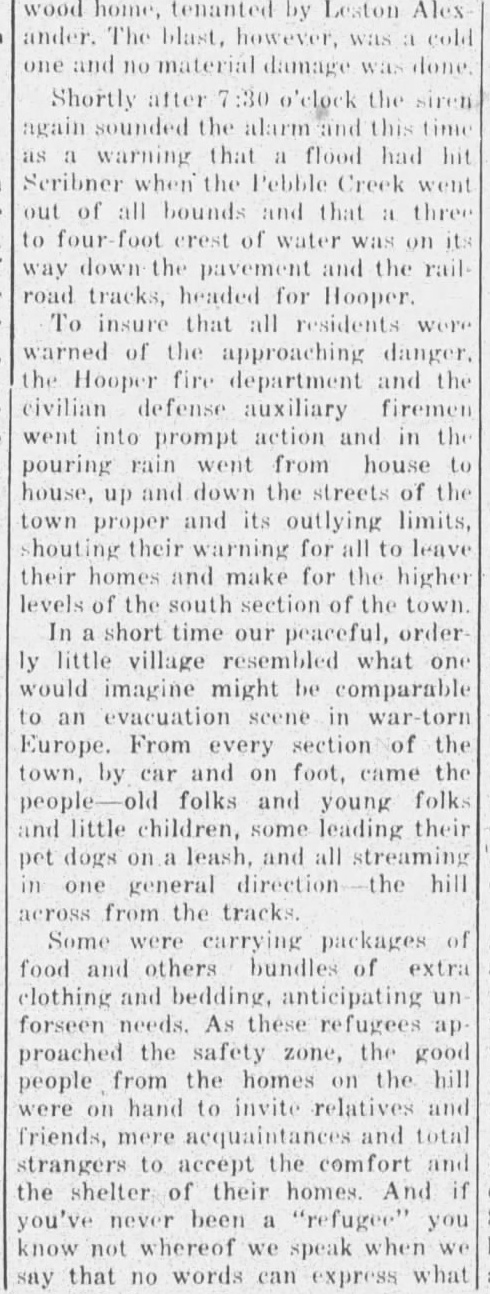
Families left by car and on foot. Some carried food, spare clothing and bedding; the account also mentions children and pets. On the hill, residents invited relatives, acquaintances and strangers into their homes. The newspaper reported that by noon most people had gathered south of the highway and on the hills, while a few remained in two-story homes. [A]
The water arrives
The reporter traced the flood’s arrival near the bridge over the old lake bed before it spread over Main Street and into basements and businesses. Conditions varied from house to house: the article described water a foot or more deep on some first floors and four feet or more in others. Those are contemporary descriptions of particular conditions, not a single measured depth for all of Hooper. [A]
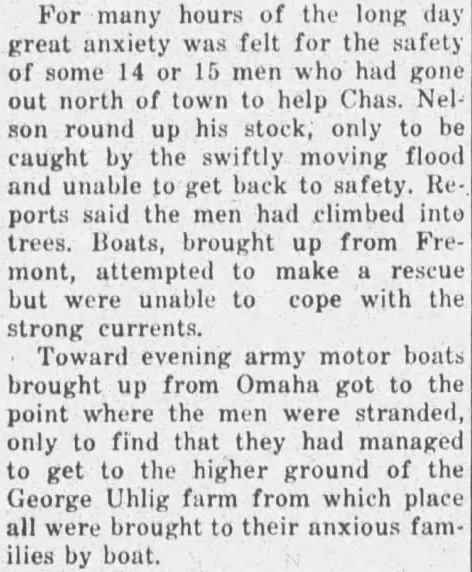
North of town, approximately fourteen or fifteen men who had gone to help Chas. Nelson gather livestock became trapped. Early rescue attempts with boats from Fremont failed against the current. By the time army motorboats from Omaha arrived toward evening, the men had reached higher ground at the George Uhlig farm. The Sentinel reported that boats brought them back to their families. [B]
A report written amid the damage
This was not a history written after all the records had been assembled. The writer acknowledged that a flooded shop and home had left little time for checking every report. The Sentinel itself could not operate its usual equipment and relied on the Perkins job shop in Fremont to produce an edition. That circumstance makes the paper a vivid local record, while also giving readers a reason to treat early dates and estimates carefully. [A][B]
The story of that morning belongs to more than one group: the people who sounded the warning, the households that opened their doors, and the boat crews and neighbors who kept looking for people still outside the safe area. The next article follows the work that began once those residents needed food, water and somewhere to recover.