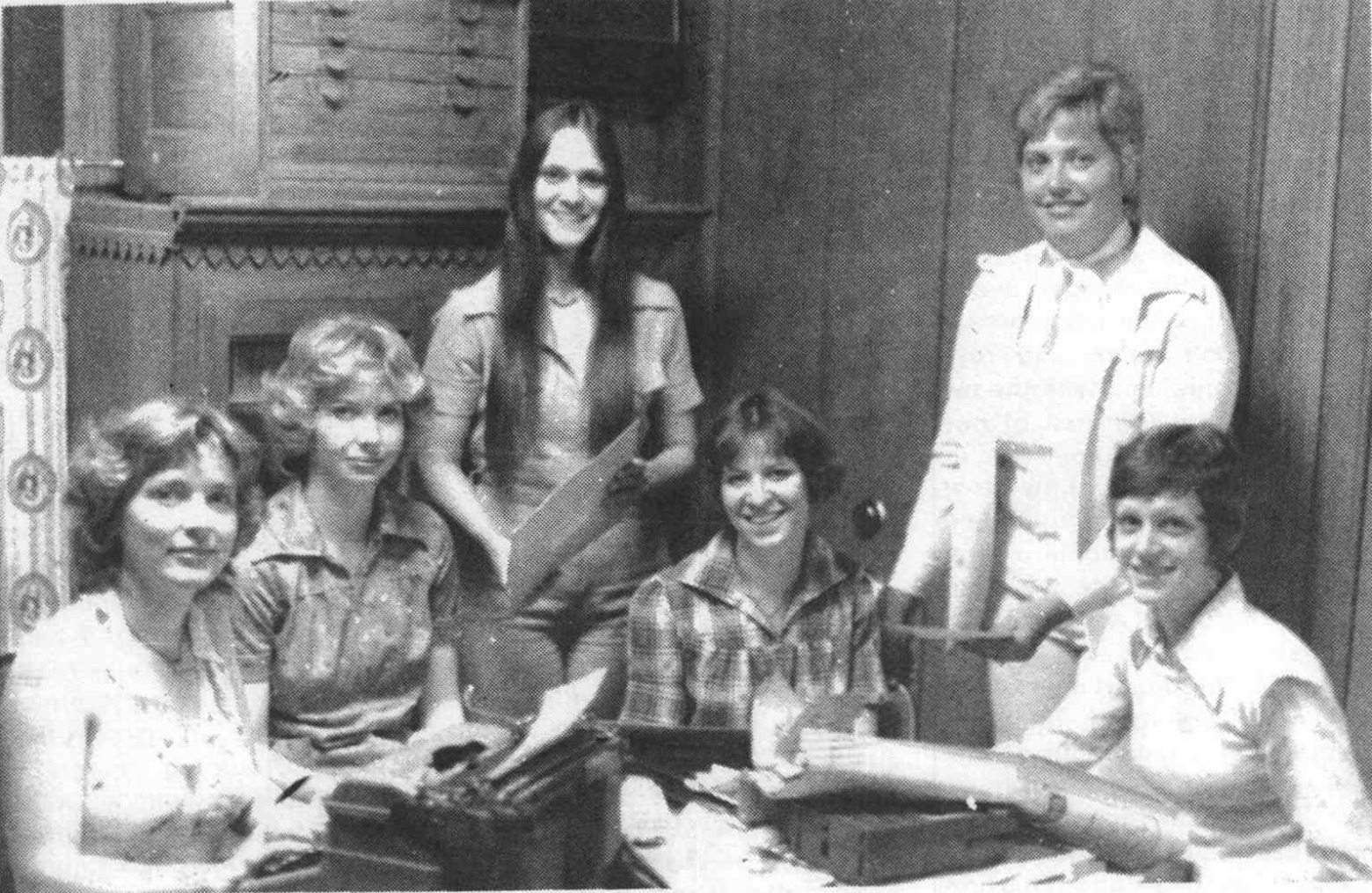
One of the best photographs of Hooper’s community work shows six women surrounded by papers. They were members of the Hooper Mrs. Jaycees, assembling the centennial history published in 1976. Marilyn Egan led the project, and Mike Egan did much of the photographic work. Their book preserved the story of dozens of organizations—including many that had already disappeared.[3]
Those groups helped furnish public buildings, maintain parks, support young people and give neighbors reasons to meet. Some were business organizations, some were lodges, and others grew out of women’s educational work, churches or shared interests. Their histories overlap, but their names should not be treated as interchangeable.
The Woman’s Club: organized in 1894
Twelve women met on October 18, 1894, and organized the Hooper Woman’s Club. They chose old gold and cream as its colors and a motto centered on women’s advancement. The centennial account describes plays, art exhibits, Christmas activities and civic programs among its early work.[1]
On March 6, 1919, the club affiliated with the Nebraska Federation of Woman’s Clubs. Nine Hooper members took part in organizing the Dodge County federation in March 1930, when Mrs. T. M. Tillman was chosen as its first county president. Hooper’s club therefore belonged to a wider network while pursuing projects at home.[1]
Hooper also planned to host the county convention at Grace Lutheran Church on September 19, 1951. Advance notices scheduled music by Hooper pupils and the Extension Chorus, with luncheon served by Zion Lutheran Ladies Aid.[28][29]

The auditorium offers a concrete example. The Woman’s Club sponsored a Community Good Will Sale on April 28, 1955, to help purchase kitchen equipment. Another sale on May 8, 1957, raised $218 during the long effort to finish and furnish the building. Its contribution sat alongside fundraising and donated work by other organizations, businesses and residents.[6]
In November 1959, the Woman’s Club recommended a Community Council with delegates from civic, club and church organizations. Formed in June 1960, the council brought together 16 organizations to consider projects and carry proposals back to their members. Its early concerns included civil defense, mosquito control and summer recreation; the centennial history connects that cooperative work with the eventual swimming pool.[6]
The club’s earlier civic work also appears in our story about Hooper women and community improvement in 1897. The record discussed here establishes its historical activity through the centennial era; it does not establish that the same organization is operating today.
A separate Young Woman’s Culture Club
On March 8, 1934, the Sentinel reported a Young Woman’s Culture Club officer reelection and household-furnishing program. A separate Woman’s Club notice distinguishes the organizations.[30]

The Project Club and its neighbors
The Hooper Project Club was a different organization. Gertrude Alperstedt’s extension history dates its beginning to March 17, 1936, when women gathered at the home of Mrs. Ernest Luther after an invitation from home-demonstration agent Helen Suchy. Twenty-three women joined. Writing in 1976, Alperstedt reported 36 members and activity in every intervening year.[2]
Extension work brought practical instruction into the community. The county program described in the book included food preparation, sewing, furniture renewal and home maintenance. Local leaders attended training and carried lessons into their clubs. When a Hooper training center needed a meeting place, Mr. and Mrs. J. Louis Alperstedt opened their home for more than seven years.[2]
Alperstedt names nine area clubs in 1939: West Logan, Hooper Extension, Elkhorn View, Happy Homemakers, Wo-He-Lo, West Bethel, Winslow Willing Workers, Harmony and East Bethel. Her 1976 list names West Logan, Hooper Extension, Elkhorn View, Dizzy Dozen, Happy Hooperettes and Koffee Klatch Klub. These were area groups, not necessarily clubs meeting within Hooper’s city limits. The account does not give each group’s founding date, and it does not explicitly explain the relationship between the names Hooper Project Club and Hooper Extension.[2]
The Commercial Club and the work of improving town
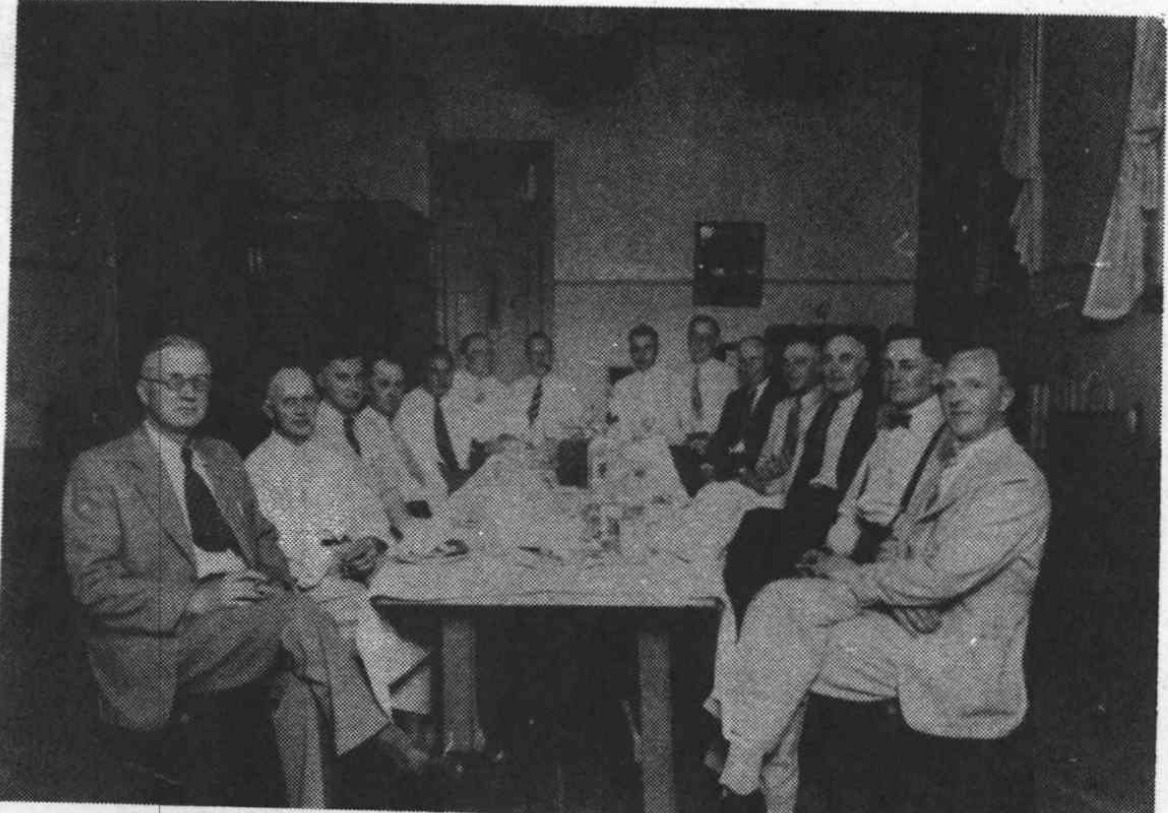
The Hooper Commercial Club promoted business, but its record reaches well beyond sales. The centennial history dates organization to 1902 and describes repeated revivals after periods of inactivity. Forty businessmen gathered at the Hooper Inn on June 10, 1920, to revive the organization, then also called the Hooper Community Club. Another reorganization followed in May 1933.[4]
The club also responded to emergencies. A June 22, 1944 Sentinel flood notice said it would pay for lost-or-found advertisements concerning missing livestock. The same notice directed residents to bring unclaimed objects washed onto their property to the vacant lot south of the former Buick garage. These small, practical arrangements belong to the larger story of Hooper’s flood recovery.[27]
Its projects included securing a band director, summer concerts, business promotions, support for Scouts and baseball, and work toward Memorial Park. In April 1945, reports indicated sufficient subscriptions to proceed with purchasing the proposed park site. A park fund accepted contributions through the club. The following years brought work on the auditorium and other community facilities.[4]
The club history also remembers hands-on work: 25 men taking part in a 1967 cleanup of the Old Lake, removing logs and debris despite difficult weather. By 1976, the Commercial Club was cooperating with the newly organized Jaycees. The older “Community Club” name should not be confused with the representative Community Council formed in 1960.[4][6]
Lions, Jaycees and Mrs. Jaycees
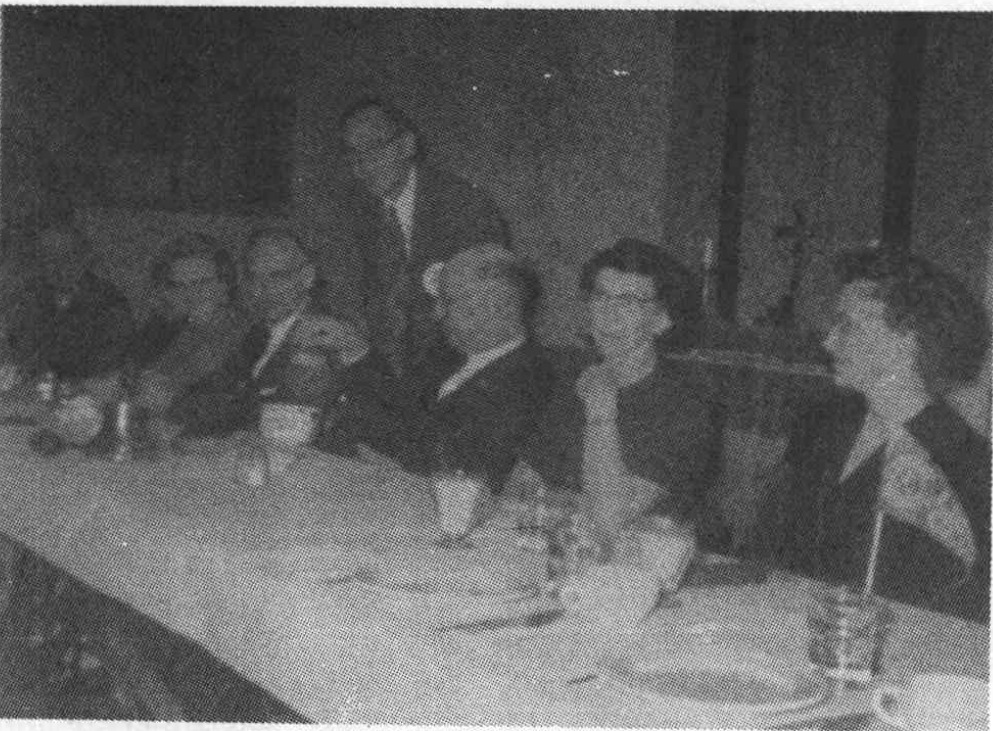
The Hooper Lions Club history gives September 12, 1951, as its charter date. The accompanying photograph identifies a dinner at the former Grace Lutheran Church as its organizing occasion. Its record of completed projects includes assistance for people with vision impairments, scholarships, Scout facilities, park furniture and recreation improvements.[5]
At the school, the Lions improved basement rooms for Boy Scouts and Girl Scouts and painted halls, stairs and the old high-school gym. Their tennis-court project began in 1952; the courts were dedicated in August 1953, with enlargement following in 1959. In 1975, Lions and Jaycees worked together on court markings, nets and lights.[5][6]
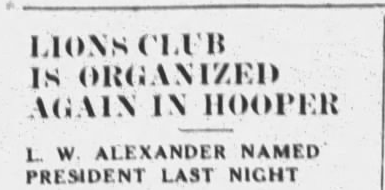
An original September 13, 1951 report resolves the apparent 1933/1951 conflict. It said an early-1930s Lions club had stopped because of economic conditions. Officers elected the previous night included president L. W. Alexander. Fremont would sponsor the reorganized club, which planned to cooperate with Hooper’s Commercial Club and other civic groups. September 1951 marked a return, rather than the first local organization.[29]
The Hooper Jaycees received their state charter in May 1974, after organizing work led by Duane Liston with help from the Gretna Jaycees. Youth wrestling, holiday activities and community projects were part of their early program.[4]
The Hooper Mrs. Jaycees followed with a charter in October 1974, aided by their Scribner counterparts. Car washes, a flea market, a winter boutique and an Easter egg hunt appear in their early history. Proceeds supported projects including children’s furniture for the library. Their most lasting historical contribution was the book that now helps us identify the people and organizations behind so much of Hooper’s community life.[3]
Lodges, fellowship and mutual support
Hooper Lodge No. 72, A.F. & A.M., traces its beginnings to 1878. The 1976 history describes the laying of its temple cornerstone on May 14, 1890, and dedication that November. The histories disagree over precise organization and charter dates, so 1878 is the sound common starting point until original lodge proceedings resolve the sequence.[7][17]
Friendship Chapter No. 122, Order of the Eastern Star, organized on February 26, 1898; its charter was dated June 23. Members helped maintain the meeting hall and supported the Masonic homes in Fremont and Plattsmouth. A particularly practical project was the stair-chair lift installed in July 1975 after members raised money to make upstairs meetings more accessible.[8]
The 2026 anniversary contributions report that Scribner’s Mystic Circle Chapter No. 126 consolidated with Friendship Chapter in 1990 and Scribner Lodge No. 132 merged into Hooper Lodge in 2022. They also describe scholarships and charitable support. These are dated accounts from the organizations’ later history, rather than evidence that every older Hooper lodge survived.[10]
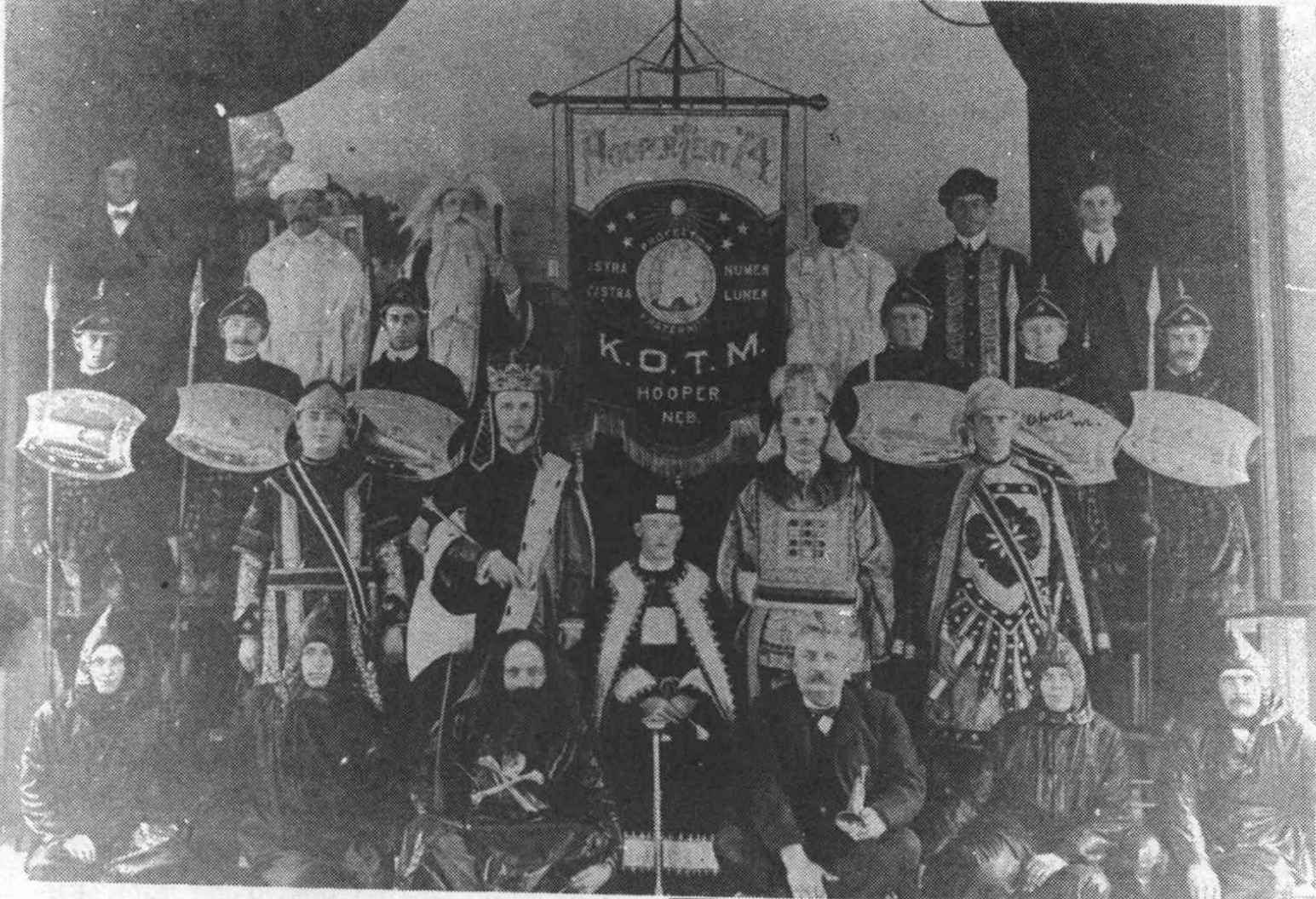
Other documented names include Longfellow Lodge No. 89, Knights of Pythias; its Frances Appleton Temple No. 39, Pythian Sisters, organized in November 1920; Hooper Lodge No. 226, Ancient Order of United Workmen; the Degree of Honor auxiliary; the Knights of the Maccabees; and a Modern Woodmen of America camp. The 1921 county history also lists several of these bodies around 1920. Its account places the Workmen’s organization in January 1892, although the two histories differ on the day.[7][9][17]
The centennial list also preserves Hooper Court No. 15, Tribe of Ben Hur, Western Bees, Royal Highlanders and Fraternal Union. It prints the names Herman Sons, Cheerusker Lodge No. 7 and Claus Groth together, without enough explanation to settle their exact relationship. These are useful research leads; names alone do not establish a founding date, membership or continuous operation.[7]
Young people, music, churches and shared interests
A notice dated October 20, 1910, reports a Hooper Boy Scout troop with 24 members. The centennial account places the first local Girl Scout troop in 1942, organized by Mrs. Harmon and another teacher. The Lions’ project list also names Cub Scouts. A separate June 22, 1922, report describes girls organizing a Campfire Girls group called Wochehapse at Bernice Cushman’s home and taking an early-morning breakfast hike.[7][9][5]
A March 8, 1934 advertisement also scheduled a Camp Fire Girls play at Hooper High School for March 20, with admission of 10 or 25 cents.[30]
Music had its own supporters. The Commercial Club helped the town band, and its account names a Band Mother’s Club Bingo stand after concerts in 1946. The history also describes the junior and concert bands associated with Paul Peterson after his arrival as a school principal in 1927.[4][20]
Church organizations belonged to this social life too. Elim’s 1976 account names Lutheran Church Women, Luther League, a Married Couples Club and the Cemetery Association. The Methodist history records women’s parsonage work in 1903 and a Ladies Aid project to bring water into the basement in 1932. A photograph supplied by Beth Heine Cobel identifies delegates at an Epworth League summer camp in Lincoln about 1905.[18][23]
The wider area also had the Dodge County Farm Bureau, the county’s early 4-H pig club, the Dodge County Old Settlers Association and the Dodge County Dairy Breeders Association. Those county references should not be mislabeled as Hooper-only organizations. A 1931 notice records a local rifle club, while Laura McGran recalled an informal men’s club room called the Hooligan Shack without supplying a date.[2][7][23]
Recreation supplied more gathering places. The 2026 golf-club contribution dates the Elkhorn Valley Golf Club organization to 1962. The earlier book separately mentions an Elkhorn Valley Recreation Association in a property transaction; the evidence does not establish that the two names represented the same body. Bowling teams and other shared pastimes are explored in our companion story on Hooper bowling and recreation.[22][26]
Service that continued in new forms
Veterans’ organizations form another important part of this history: Upton Post 133 of the Grand Army of the Republic, the Woman’s Relief Corps, Porter Camp 119 of the Sons of Veterans, American Legion Post 18, Legion Auxiliary Unit 18, American War Dads and Hooper VFW Post 7616. The books also record a wartime Home Guard Company. These were separate organizations, and the Woman’s Relief Corps should not be confused with the Woman’s Club.[24][25]
Read the separate histories of Hooper’s American Legion, Auxiliary and VFW, including the distinction between Atomic Bomber Post 7616 and David Hargens Post 10535.
The Hooper Volunteer Fire Department belongs alongside the clubs in an account of organized volunteer effort, though it is a public-service organization with a different purpose. Its 2026 contribution dates surviving printed records to 1898 and remembers its 125th anniversary in 2023.[21]
The Hooper Senior Citizen’s Center began in 1978, according to the 2026 history, with noon meals at the auditorium. Ed and Sophie Kerstein donated the building at 208 North Main Street in 1980; community contributions helped prepare it. The account describes bridge clubs and a local church group called ERMAA sponsoring Bunco. The book does not expand that acronym. ENOA’s May 2026 directory independently confirms the center’s listing.[11][16]
The Hooper Area Community Foundation, established in 2008, provides a more recent example. Its official records document a $5,000 matching grant that created a $10,000 endowment in 2009 and the completed highway gateway sign in its 2010 annual report. In February 2026, the Fremont Area Community Foundation announced a $5,000 grant to support Hooper’s 150th celebration. These records show community organizing continuing under a new name and structure.[12][13][14][15]
The Nebraska Library Commission also lists a Friends group for Hooper Public Library. That directory entry does not supply its founding date or current program, but it adds another name to the record of local support.[19]
Minute books, membership booklets, event programs and labeled photographs could fill many remaining gaps. If your family kept records from one of these groups, share the organization’s name, an approximate date and what you know about the people pictured. A small detail may connect an unfamiliar club name with a project Hooper still remembers.