Two stops on Hooper’s historical tour share a surname and a street. At 105 South Park Street, the guide identifies the brick home of hardware merchant John F. Heine. At 101 South Park Street, it identifies the home of Dr. Clinton Heine, with a first-floor room that served as his office. Together, these houses connect the town’s residential streets with the people who supplied its farms and cared for its residents.[1]
The hardware merchant at 105 South Park
The tour dates John F. Heine’s house to 1893. His arrival in Hooper is documented more precisely in the county history published in 1921: July 10, 1882. Before coming to Nebraska, he had worked as an iron moulder in Pennsylvania. In Hooper, he entered the hardware and implement business with his brother George F. Heine.[1][2]
The family account preserved in Hooper’s 1976 centennial history describes a business with a broad reach into everyday work. Its stock included McCormick farm machinery, buggies and carriages. There was a tin shop, and Fred Heine operated a well-and-plumbing business at the west end of the store. The account makes clear why “hardware merchant” meant more than selling small household supplies: the family’s work served farming, transportation and water systems.[3]
The hardware business changes hands
A contemporary newspaper records the end of the Heine firm. On April 15, 1920, the Sentinel reported that G. S. Olson of Newman Grove had acquired J. F. Heine & Son’s hardware business. The report explicitly excluded the buildings from the deal. It said John F. Heine had died the previous May and his heirs had decided to sell the business to settle the estate. This was a business transaction; it does not establish a sale of the Park Street house.[7]

A photograph that helped preserve a house
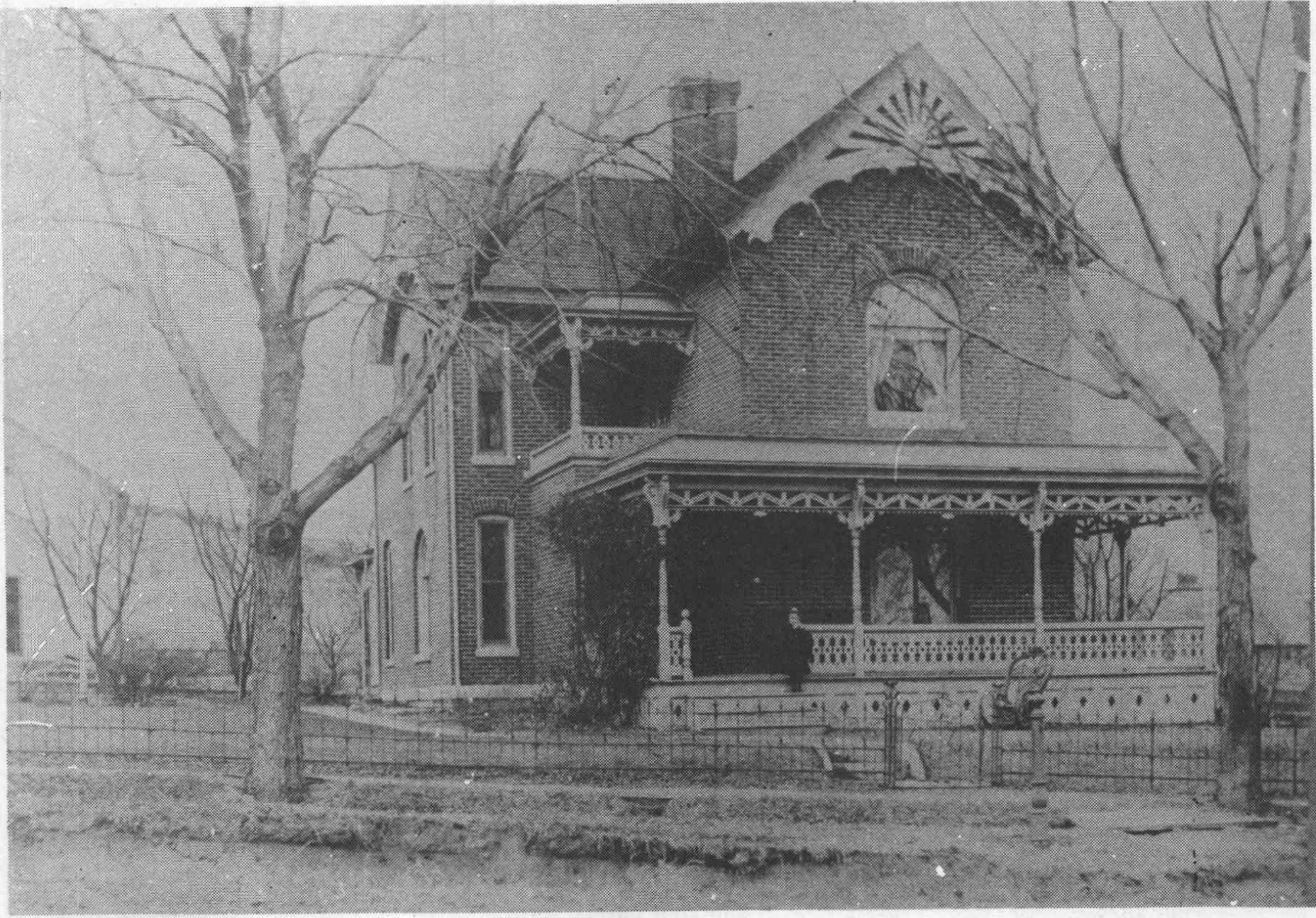
The most revealing source for the house itself is a photograph printed in the centennial history. It shows the brick walls, porch railings and elaborate woodwork beneath the gables. The book identifies the building as John F. Heine’s home and says that Ada and Julia Heine lived there for many years. John’s daughters Ada and Julia also appear among his children in the 1921 county biography.[2][4]
By 1976, the photograph had acquired a second purpose. The centennial account says it was used to guide restoration of the detailed wooden trim. That is a particularly useful piece of local preservation history: an old family or community image became a practical record of how part of a building had looked.[4]
The photograph is undated. Nor does the centennial book establish the tour’s exact 1893 construction year; its description places the house broadly around 1900 or earlier. The tour supplies the more specific date, which remains a good question for a future search of construction notices and property records.[1][4]
The physician at 101 South Park
The next house’s story belongs to medicine. The tour dates Dr. Clinton Heine’s home to 1920 and records an office in one first-floor room. It does not say which room, when the office opened or how long it operated there.[1]
The 1921 county history describes Clinton D. Heine’s preparation for that work. He earned a pharmacy degree at Creighton in 1906, a scientific degree at the Nebraska State University and a medical degree at Rush Medical College in Chicago. His hospital training included six months at St. Joseph’s Hospital and two years at St. Luke’s Hospital, both in Chicago.[5]
By 1921, Clinton practiced in Hooper with his brother, Dr. W. Howard Heine. The same account records Clinton’s overseas service during World War I with Base Hospital No. 53, where he held the rank of captain. Hooper’s centennial history also lists Dr. C. D. Heine as the local American Legion commander for 1921.[5][6]
A March 8, 1934 notice scheduled the Woman’s Club at Mrs. C. D. Heine’s home the following day. It provides no address, so it cannot independently place the meeting at 101 South Park.[8]
These are distinct histories within the Heine family. Clinton’s physician brother was W. Howard Heine; John F. Heine’s son J. Howard was a banker. Keeping those initials straight matters when following the family through directories and biographies.[2][5]
The two tour stops offer different ways to read a historic home: one through an early merchant and a photograph used in restoration, the other through a physician’s training, service and home office. Explore their individual records at 105 South Park Street and 101 South Park Street.