
Hooper and the Flood of 1944 · Part 4 of 5
As the water receded enough to enter buildings on Monday, Hooper began another kind of emergency. Mud covered rooms and accumulated around properties. The June 15 Sentinel expected cleanup to take weeks and possibly months. Its reports of pumps, water service and mail delivery show a town recovering one function at a time. [C]
Pumping out the town
Two fire-department pumpers began work in business basements on Monday. The paper reported additional private pumps, equipment from the army air base, and two pieces of equipment from Omaha’s civilian-defense headquarters arriving Tuesday evening. High water made the work slow. The return of water service on Tuesday, using a tractor engine, helped speed the cleanup. [C]
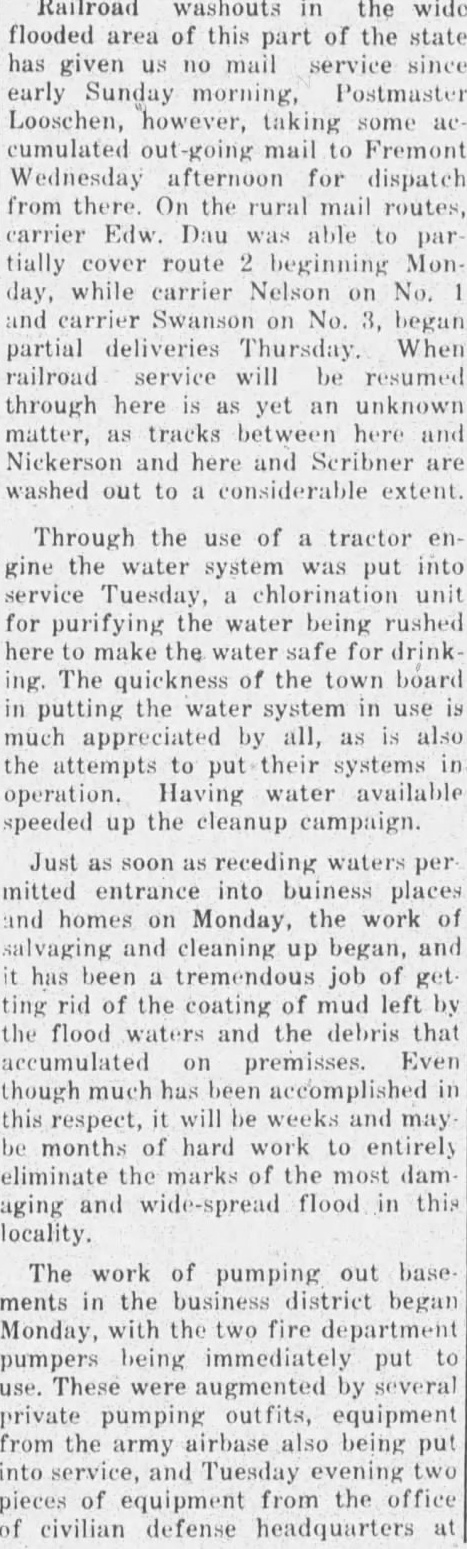
Power had returned to Main Street businesses and the area south of the tracks and on the hill by Tuesday evening. Other homes required checks of their connections and water-damaged basement lines. Rural mail delivery also resumed unevenly: the Sentinel named partial service on Route 2 beginning Monday, followed by carriers Nelson on Route 1 and Swanson on Route 3 on Thursday. Recovery did not have one universal reopening date. [C]
Finding property and asking for help
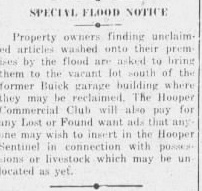
A June 22 notice asked people to bring unclaimed property to the vacant lot south of the former Buick garage. The Commercial Club offered to pay for lost-and-found advertisements for livestock. These small arrangements addressed losses that were hard to capture in a county damage total: belongings carried away and animals whose owners did not know where they had gone. [D]
The Sentinel also announced a Friday meeting about recovery. The Fremont Guide and Tribune’s June 24 report described the ensuing discussion of outside help and equipment for cleanup. Participants considered labor and machinery needs across the flooded area. The article records proposals, including approaches for assistance from the Scribner air base; it does not establish that every proposal was approved or carried out. [D][F]
The library’s longer wait
By September 23, the Fremont paper could report that Hooper’s public library was open again for the first time since the June 11 flood. Water more than two feet deep had damaged books, walls and floors. New linoleum was a gift from the American Legion Auxiliary. The short item does not give a day-by-day account of the repairs, but it makes clear that an ordinary community service had remained disrupted well beyond June. [G]
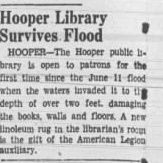
The library notice is a useful place to end a recovery story precisely because it is small. The emergency sirens were no longer its subject. Books, a floor and an open door were. Alongside the large rescue effort, the newspapers preserve those modest signs that people could use their town again.