A church name in an old Hooper obituary may not appear on a sign today. Zion and Grace became Redeemer. Three congregations came together as Faith United Methodist. The former Faith building now houses Spirit of Peace. Following those names reveals how families built places to worship, teach children and gather with their neighbors—and how those places changed as the community changed.[2][3][4]
The story reaches back beyond the surviving buildings. Early services took place in homes, schoolhouses, the railroad depot and City Hall. Some congregations eventually joined together; others kept their own identities while sharing a pastor. Here is how Hooper’s principal church histories fit together.
Before the steeples: a depot and a shared church
The Hooper Methodist congregation began in 1872 under the Reverend George DeLaMatyr, with the railroad depot as its first meeting place. A separate Presbyterian account, written by pastor Joel Warner and preserved in the 1976 centennial book, describes preaching in Hooper’s schoolhouse in 1878. Warner organized the Presbyterian church on April 20, 1879. Its brick building was dedicated March 7, 1880.[1][2]
The Presbyterian building served more than one group. The Methodist history remembers Presbyterians and Methodists worshipping there, each with its own pastor. The Lutheran history describes German Lutheran meetings there as well. A church building could provide a foothold for another congregation before that group could afford a home of its own.[2][3]
Warner called the Presbyterian church Hooper’s first church building and one of its early brick structures. He recorded its demolition in March 1919, thirty-nine years after its dedication. His detailed account supplies the 1880 dedication date used here; the Methodist section of the same book gives a conflicting 1870 construction date.[1][2]
Zion and Grace: two languages, two congregations
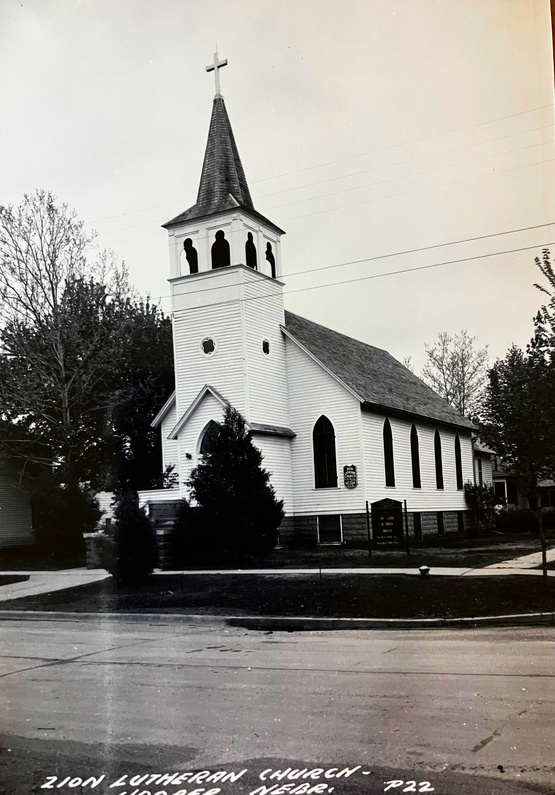
Gertrude Alperstedt’s history traces Zion’s beginnings to Lutheran meetings in the Presbyterian church in March 1880. The congregation formally organized on March 1, 1890, as First German Evangelical Lutheran Zion Church. It bought two lots at Cedar and Elk streets from Johann B. Wagner for $200 and was worshipping in its own building by December that year.[3]
Zion developed a small church campus. A parsonage followed in 1893, and a schoolhouse south of the church in 1900. The book identifies the school as a German school. Language also explains the next chapter: in 1915, August E. Hecker and others wanted Lutheran Sunday school and worship available to families who did not speak German.[3]
The county history published in 1921 describes Zion’s frame church with a seventy-foot tower. That account counted 248 confirmed members and sixty Sunday-school pupils. The schoolhouse, parsonage and church together show how much congregational life extended beyond the worship service.[10]
The centennial history reproduces the substance of an April 1915 newspaper invitation to an English Lutheran Sunday school at City Hall. Grace Lutheran’s first worship service followed on May 2, 1915. The congregation met in City Hall for about nine months while arranging a permanent building and a pastor. Its new church at Spring and Elk streets was dedicated November 5, 1916.[3]
The congregation did not wait for every part of its new church to be finished. Perry A. Hudkins built it for a reported $4,795, and worship began in the basement on August 13, 1916. A funeral, a wedding and two baptisms took place during the period before completion. By the time of the 1921 county history, Grace had 178 members and 125 Sunday-school pupils—an established congregation that had begun in a borrowed room only a few years earlier.[3][10]
Zion’s work also reached into the countryside. History Nebraska’s finding aid for St. John’s Ridgeley, near Scribner, records service by Zion pastors from 1929 through 1941. The centennial book dates the arrangement’s beginning to 1930; the one-year difference remains unresolved. This was shared pastoral service, and Ridgeley was a separate congregation from the St. John’s church later moved into Hooper.[3][12]

Coming together as Redeemer
On April 9, 1958, Zion and Grace held separate congregational meetings to consider a merger. They met together on April 27 and chose the name Redeemer Lutheran Church. Redeemer’s first service took place that May in the former Grace building. Its first combined Sunday school met October 1.[3]
The old Grace property continued to change under its new congregation. The self-guided tour dates a parsonage south of the church to 1960 and describes a passage linking the two basements. Those improvements came after the merger: they belong to Redeemer’s years at the former Grace site.[14]
The merger came before the building now associated with Redeemer. The congregation selected its new site on Fulton Street in May 1965. Groundbreaking followed March 6, 1966, and dedication services were held October 1–4, 1967. The centennial account placed the cost at about $300,000.[3]
The construction project also bridged a change of pastors. A contract with Fauss Construction was awarded January 15, 1966. The Reverend Grant Van Boening resigned in February; the Reverend Henry D. Gittler was installed in July, and the cornerstone was laid November 6. The sequence reflects a congregation carrying a major project forward through a change in leadership.[3]

Today Redeemer’s official website identifies its location as 601 East Fulton Street and continues to list worship, Sunday school, children’s ministry and community activities. For families tracing Zion or Grace records, Redeemer is the later congregation formed from both—not simply a new name for one old church building.[3][5]
From Hooper Methodist to Faith United Methodist
The Methodists’ depot beginnings eventually led to their own church. Trustees met at the Lyman Richards bank in February 1884 to plan a building. A thirty-by-fifty-foot church was erected for $3,200 on land donated by Orlando A. Himebaugh; the centennial history dates its dedication to July 31, 1885.[2]
A home for the pastor followed. An 1892 Methodist conference report, preserved in a NEGenWeb transcription, praised Hooper’s new six-room parsonage and said it was almost free of debt. The centennial book gives 1891 for the parsonage, while the tour gives 1892. The contemporary report establishes that it was in place by the 1892 reporting period without settling the exact completion date.[2][11][14]
After the school fire, church space helped keep public education going. The January 30, 1908 Sentinel announced classes in the Methodist classroom and the German Lutheran church’s school building, with the Methodist bell serving as a school bell. Our account of the fire and rebuilding debate follows the wider emergency.[17]
The building changed with its congregation. A basement was begun in 1909. In 1932, the Ladies Aid received permission to bring water into it. The June 1944 flood tore away the west and north basement walls. Later improvements included a new altar, pulpit, railing and pew in 1947, followed by stained-glass windows in 1952.[2]

Faith brought together three local histories. Bethel, organized in Maple Township on February 16, 1874, began with services in the Brown schoolhouse and built a church in 1878. The Winslow Evangelical United Brethren congregation traced its beginnings to Clark Creek meetings in 1874. It organized as a congregation on January 31, 1877, built in 1888 and later relocated to Winslow, reusing lumber from its earlier church in the new building dedicated in 1926.[2]
The Winslow E.U.B. congregation’s last service was October 6, 1968, followed by its merger with the Hooper congregation. Bethel joined in June 1969. The centennial history identifies the resulting congregation as Faith United Methodist. Bethel and Hooper had already shared a pastor beginning in 1926, so cooperation preceded the formal union by decades.[2]
A new building, then a new congregation on Maple Street
The 150th-anniversary book carries Faith’s building history beyond 1976. It records the old church’s demolition in 1980 and construction that year of a new sanctuary and kitchen by Woerman Construction of West Point. A bell tower followed in 1987; a fellowship hall, office, two classrooms and storage space were added in 1991.[4]
The same book records the building’s sale in 2023 and its subsequent use by Spirit of Peace. Spirit of Peace’s own website identifies the church at 303 West Maple Street and documents worship, meals and community invitations there in 2026. This is a change in the building’s use by congregations; the available sources do not establish that Faith simply changed its name to Spirit of Peace.[4][8]
St. Rose: from a family home to a parish
Hooper’s Catholic history begins in the centennial account with the John Bodewig family, who settled in the Maple Creek area in 1869. Father John Mueller celebrated Mass in the Bodewig home about 1881. A Catholic church was built in Hooper in 1885 and served by visiting priests from neighboring communities.[6]
The building and the formal parish have different starting dates. St. Rose of Lima received parish status on June 14, 1917, with Father Emil A. Klemenz appointed resident pastor. The centennial history later describes enlargement and remodeling begun in 1954, after the small frame building had become too small for its congregation.[6]
One part of the building chronology still needs a dedication notice or parish construction record. The self-guided tour labels the pictured St. Rose building “Built in 1920.” The centennial account’s 1885 church and 1954 enlargement do not explain that label, so we cannot yet say what was newly built or retained in 1920.[6][14]

Shared ministry was part of St. Rose’s story from its first resident pastor: Father Klemenz also served missions in Scribner and Ridgeley. By 1976, the centennial account described a four-parish Crescent Cooperative Ministry, with Sisters Effie Preddy and Rosanne Plagens serving as associate pastoral ministers. Alongside those arrangements, gatherings such as the annual October turkey dinner became part of the parish’s community life.[6][4]
St. Patrick’s official parish history dates St. Rose and St. Lawrence of Scribner joining its parish family to 2019. St. Charles Borromeo of North Bend and St. Leo of Snyder followed in 2023. That account supplies the participating churches’ own explanation of the more recent relationship.[13]
St. Rose remains listed as a church on the shared parish website, with a Mass schedule, parish council and the address 405 East Elk Street. Those shared arrangements should not be mistaken for the disappearance of the Hooper church. Its cemetery preserves another part of the community’s history: the anniversary book describes early gravestones and improvements made during Father Edgar Wortmann’s pastorate, including the brick entrance dated 1966.[7][4]
The rural churches belong in the story, too
Hooper’s church history extends into the surrounding countryside. St. John’s began with services in 1869 and eventually brought its rural church building into town in the mid-1950s. The anniversary book records its final service on June 24, 2012. Our history of St. John’s church moves follows its different buildings and locations, including new newspaper evidence about the mid-1950s move.[4]
Rural St. Paul’s, founded in 1870, and Elim, founded in 1871, continue as distinct congregations. Their official history explains that they have shared a pastor through a cooperative ministry since 2000 while retaining independent congregational status. St. Paul’s is at 1843 County Road E; Elim is at 2312 County Road D, also called Swaburg Road. This rural St. Paul’s is a different congregation from St. Paul’s of Winslow mentioned in St. John’s history.[9][4]
Read more about St. Paul’s rebuilding after the 1880 storm and the family account of Elim’s winter lumber journey. Those stories preserve the work behind the rural churches without losing sight of their continuing communities.
Shared work beyond the church doors
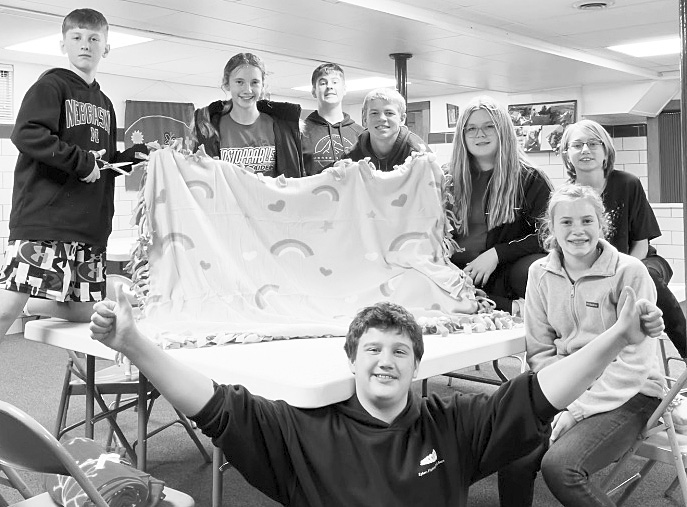
Newspaper photographs record how that cooperation worked in practice. In December 2022, Pastor Judy Johnson reported that Elim and St. Paul’s confirmation students had assembled Christmas bags for six Ukrainian families resettled in Norfolk. They made six fleece blankets and selected gifts with the families’ children in mind. The account describes the preparation through Orphan Grain Train; delivery was still planned when it was published.[15]
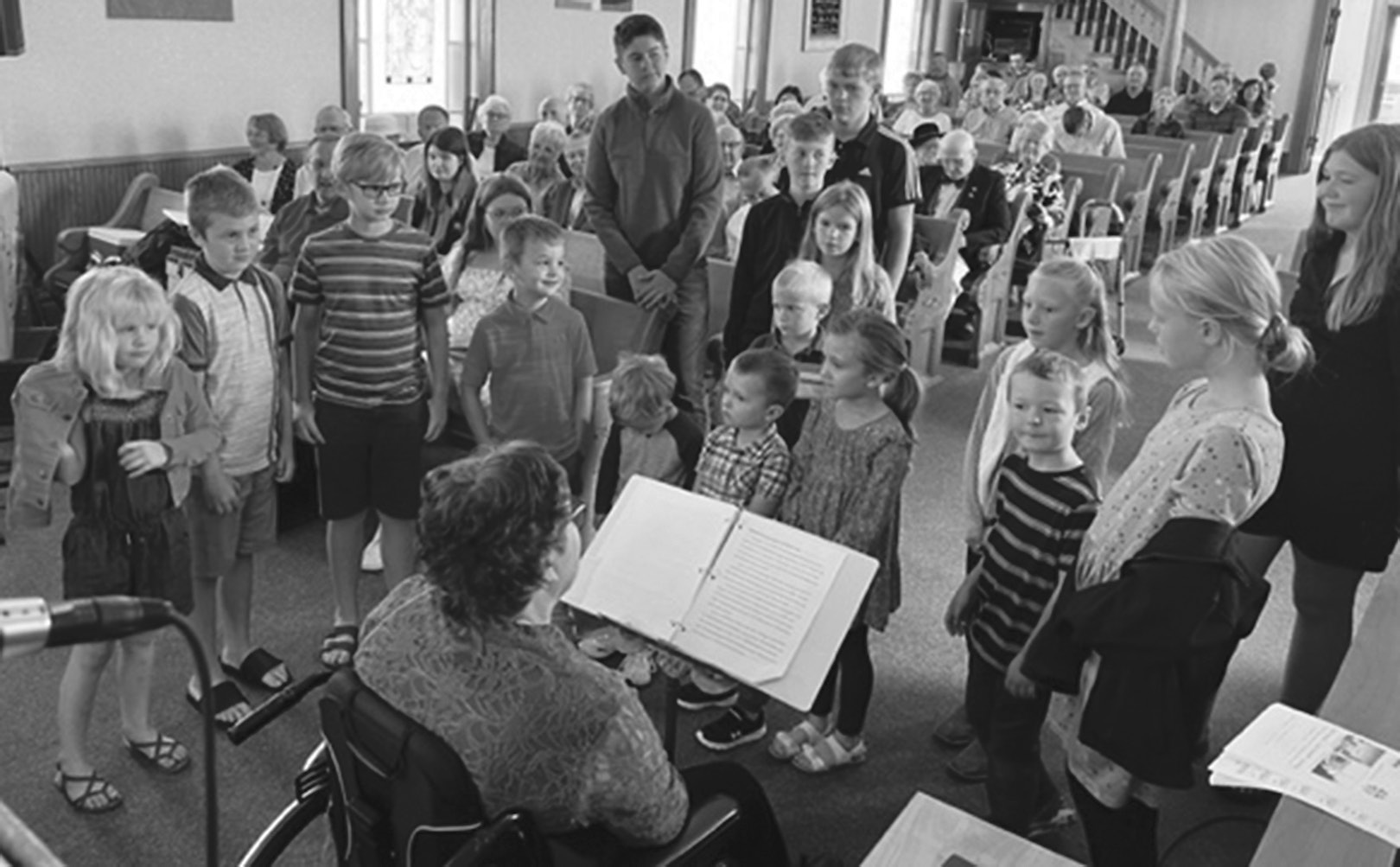
Music provided another meeting point. A September 2023 notice announced a joint Polka Sunday at St. Paul’s, with a special offering intended for the fire and rescue departments of Scribner, Hooper, Winslow and Uehling. Its accompanying photograph looked back to children taking part in the 2022 service. These dated pages preserve congregational life alongside the older histories of construction, moves and mergers.[16]
Following the history today
The surviving names and buildings make more sense when their separate histories stay connected: Zion and Grace became Redeemer; Hooper Methodist, Winslow E.U.B. and Bethel came together as Faith; the former Faith property now serves Spirit of Peace; and St. Rose continues within a wider parish family. A change of address, a shared pastor and a congregational merger are different events, even when all three appear in one family’s memories.
For current worship and community activities, use the congregations’ own sites: Redeemer, Spirit of Peace, St. Rose of Lima and Elim and St. Paul’s. Dated photographs, dedication programs and church anniversary booklets can help fill in the earlier chapters. If your family has something to share, contact Celebrate Hooper.
Locate the former Zion and Grace sites, Redeemer, St. Rose and the Maple Street church in our self-guided tour records.