St. Paul’s new church was almost finished when the storm came. Construction had begun in 1879; in 1880, the building was ruined. Hooper’s centennial history records the congregation’s response in a few words: it rebuilt immediately. The Nebraska State Historical Society’s account preserves the same sequence. Before the familiar church of 1902, there was this earlier building—and the work of starting it over.[1][2]
A congregation before a permanent home
St. Paul’s grew out of Lutheran worship in the countryside around Logan Creek. The centennial account dates a service at the Monnich log schoolhouse to January 30, 1870, and the adoption of a constitution to February 13. These beginnings belonged to a landscape of schoolhouses and scattered families, before a permanent church site had been settled.[1]
Choosing that site was difficult. One group wanted to be near the Logan school; another preferred the Monnich school. They eventually formed independent congregations that could still cooperate. The book says a death among St. Paul’s members made the cemetery question urgent, and a twenty-two-acre tract became available for the church property. It does not name the person whose death prompted that decision.[1]
Rebuilding a rural gathering place
The church begun in 1879 measured forty by twenty-six feet. After its destruction and rebuilding, the account records a bell, a Sunday school and the conversion of the older church-parsonage into the pastor’s residence. A separate schoolhouse followed in 1885. Together, those buildings supported worship, teaching and the everyday work of the congregation.[1]
One small detail helps bring that setting into focus: horse sheds were erected in 1892 for members attending services. They remained until 1939. The churchyard therefore changed with the way people traveled, as well as with the congregation’s need for space.[1]
The church of 1902
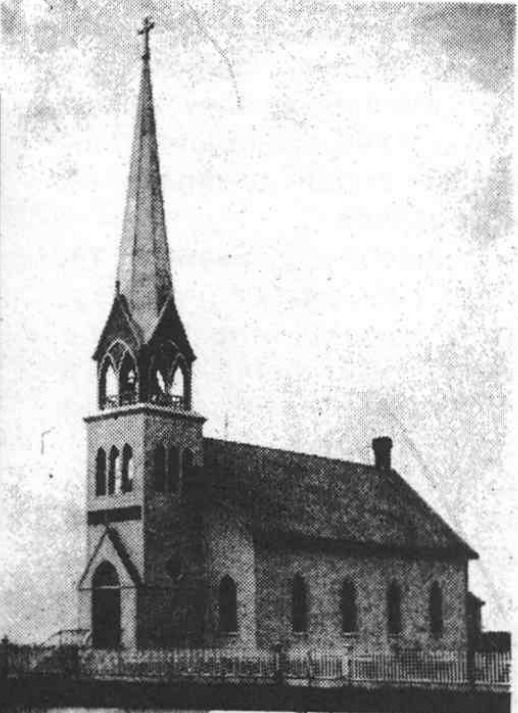
Members voted for another new church in 1901, and its cornerstone was laid in 1902. The centennial history puts the furnished building’s cost at $6,000. It also lists $350 for pews and $620 for the pipe organ. The accompanying photograph records its tall steeple and the fence enclosing the grounds.[1]
Changes continued inside. In 1917, the congregation introduced some English services and a partly English Sunday school. In 1925, its seal changed from German to English. A new basement was dedicated in 1941, and members voted for a new pipe organ in 1947. The history is a succession of decisions made by people keeping a shared place useful.[1]
A gathering 150 years later
Nearly 200 people attended St. Paul’s anniversary service on September 12, 2021. The Oakland Independent pictured worshippers inside and gathering outside afterward. Guest preacher Becky Sells was identified as the congregation’s first daughter to enter ordained ministry—a connection between its long history and a later generation.[4]

The names behind the buildings
The state archives describe a microfilmed collection containing St. Paul’s 1970 centennial history, German-language minutes and registers spanning 1873–1956. The registers include baptisms, marriages, burials and deaths. Those entries have not been examined for this article, but the inventory identifies a way to follow the families behind the building chronology.[2]
St. Paul’s remains at 1843 County Road E. Its official website describes a shared ministry with Elim while each congregation retains its own identity.[3] If your family has a labeled church photograph, a school picture or a program from an earlier dedication, we would welcome a copy through Celebrate Hooper. Names and dates written on the back can help connect these buildings to the people who used them.