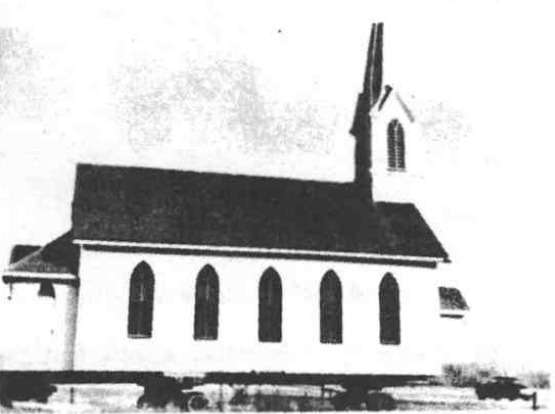
The photograph shows St. John’s away from its foundation, its long wall of pointed windows intact as the church is moved. It records the congregation’s decision to bring its rural building into Hooper in the mid-1950s. For St. John’s, moving a church was already part of the family history: an earlier building had made a different journey in 1881.[1]
Worship in a schoolhouse and a pastor’s home
Hooper’s centennial history dates the congregation’s first service to April 26, 1869, in a log schoolhouse near the Elkhorn River bottom, two miles northwest of Hooper. Pastor A. W. Frese traveled to conduct services. His brother E. J. Frese became the first resident pastor, ordained and installed on July 11 of that year.[1]
A house for the new pastor was nearly finished when he arrived. His installation took place there, and the congregation gathered in it for Sunday services until attendance outgrew the space. A public schoolhouse provided the next meeting place.[1]
The first purpose-built church measured twenty-six by forty feet. It stood one and a half miles north and one mile east of Hooper and was dedicated on Christmas Day, 1871. That location was the beginning of the congregation’s building history, rather than its permanent address.[1]
The first move
As other congregations developed, the geography of St. John’s membership changed. The centennial account explains that Immanuel, organized east of Hooper in 1876, took over parish work in that area. Most St. John’s members then lived north and west of their church.[1]
Plans followed for a site five miles to the northwest on five donated acres. A parsonage was built there in 1878, with a room used for school. The church itself was moved in 1881. A schoolhouse followed in 1887, and St. John’s pastors taught there for many years.[1]
A new church building replaced the earlier one in 1911. In 1919, the congregation marked its fiftieth anniversary and installed a pipe organ late in the year. The book notes that German was still used for worship and instruction, and that descendants of the first members remained in the congregation.[1]
Bringing the church into town
Early in 1954, St. John’s and St. Paul’s of Winslow discussed merging and building a new church in Hooper. St. Paul’s decided against the merger. St. John’s chose to move its existing building into town, enlarge it and provide a basement.[1]
The centennial book gives conflicting dates for the move: its narrative says December 1954, while the photograph caption says 1955. The dedication of the expanded facilities is dated May 27, 1956. A new parsonage was built beside the church in 1959.[1]
A contemporary newspaper places the planning later than that December 1954 date. The July 14, 1955 Hooper Sentinel reported that St. John’s July 10 voters’ meeting gave priority to moving the church into Hooper. The congregation directed its committee to dispose of the residence on the recently acquired former Tillman property. It also authorized an organ expert to dismantle the instrument before the church moved and reassemble it afterward. The move was still ahead of the congregation at that meeting; its actual transport day remains unverified.[2]

These were two separate moves, involving two different church buildings. The first followed the changing distribution of a rural membership; the second brought an established congregation’s building into Hooper.
If your family photographed the town move, saved the 1956 dedication program or remembers the work through a dated letter, we would welcome a copy at Celebrate Hooper. Photographs of the route and the people handling the move would help fill in the remarkable event captured in this small surviving image.