
They left home at three in the morning on a cold February 3. The route took the wagons across the frozen Missouri River and through a dark forest to an Iowa lumber camp. By the time they brought their load home, it was about midnight. Luella Sampson preserved that account from her father in Hooper’s centennial book, explaining how cottonwood lumber reached the settlers building Elim’s church.[1]
It is a family recollection, and a vivid one. Sampson places it in her discussion of the church built in 1874, but does not explicitly give the year of the February journey. The details we can safely carry forward are the ones she records: the wagon caravan, the river crossing on ice, a meal brought from home and the long return trip.[1]
Before the name Elim
The congregation began as Scandia on July 2, 1871, among Scandinavian immigrants in the Swaburg area northeast of Hooper. Sampson says the founders purchased forty acres of prairie from the Union Pacific Railroad for $200. Members took turns working the church land, including breaking ground that could be rented for crops.[1]
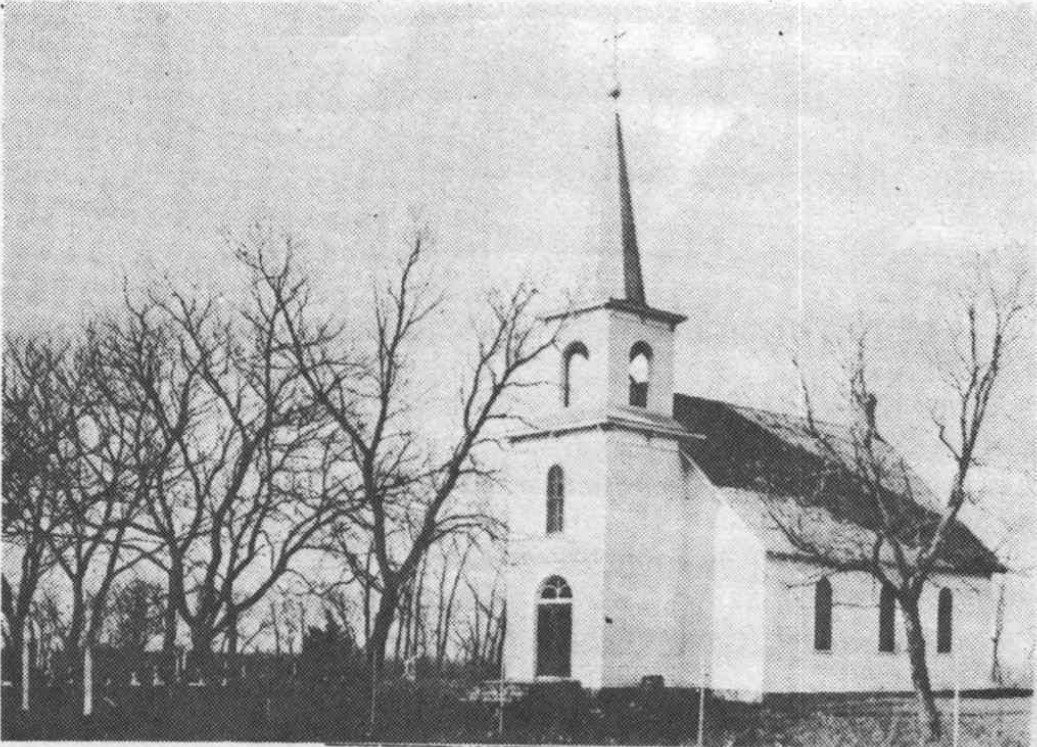
Early meetings took place in the home of chairman Pilot A. Anderson and in a schoolhouse. In 1874, the pioneers built the church themselves. Cottonwood from Iowa supplied its inner frame, giving the lumber-trip memory a specific place in the building’s story. The congregation reorganized in 1886 and adopted the name Elim.[1]
A building made through many contributions
The church did not acquire every familiar feature at once. Its tower was added in 1895. Sampson credits the early Ladies Aid Society with giving the bell and high altar, and a former pastor, J. E. Lindberg, with designing and building the pulpit. In 1917, the congregation enlarged the building and added a basement.[1]
These details give the church’s fittings their human connections. The frame required a journey for materials; the bell came through an organization’s gift; the pulpit reflected a pastor’s work. The account remembers a series of contributions rather than a single construction day.
The gates and the churchyard
Sampson also followed the changing boundary around the cemetery. An early fence used boards on cedar posts, topped with barbed wire. Later, Hooper residents donated woven-wire fencing, and the grounds were fenced again in 1937.[1]
The entrance gates had makers of their own: Lola Johnson and John P. Young fashioned them in Johnson’s farm blacksmith shop. Parmalee Monument Works of Tekamah donated the stone pillars. Sampson remembered the entrance as a place through which generations passed for Sunday school, weddings, worship and funerals. She did not reduce the churchyard to one kind of occasion.[1]
In 1922, Elim became a single parish after earlier arrangements with churches in Oakland and Fremont, and changed its program from Swedish to English. By the time Sampson wrote, its community Midsummer Festival was another longstanding part of life on the church grounds.[1]
Another generation gathers its history
For Elim’s planned September 26, 2021 anniversary celebration, the Oakland Independent announced a history book written and compiled by Bobbie (Engdahl) Gahan. It identified the volume as covering the congregation from 1871 onward, adding another named local historian to the record Sampson helped preserve.[3]
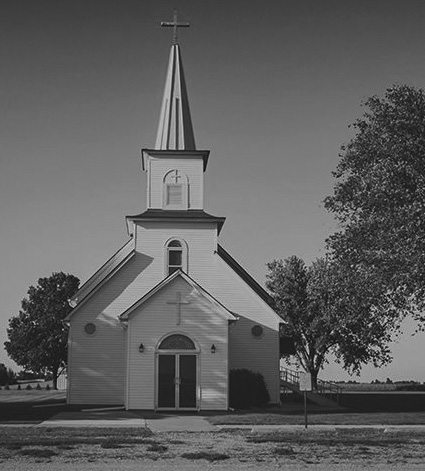
Elim’s official website places the church at 2312 County Road D, also called Swaburg Road, and describes its shared ministry with St. Paul’s.[2] If you have an old photograph of Elim’s entrance, the blacksmiths’ work or a family gathering at the church, please share it with Celebrate Hooper. A name or date attached to that picture would help continue the careful remembering Sampson began.