
Hooper and the Flood of 1944 · Part 3 of 5
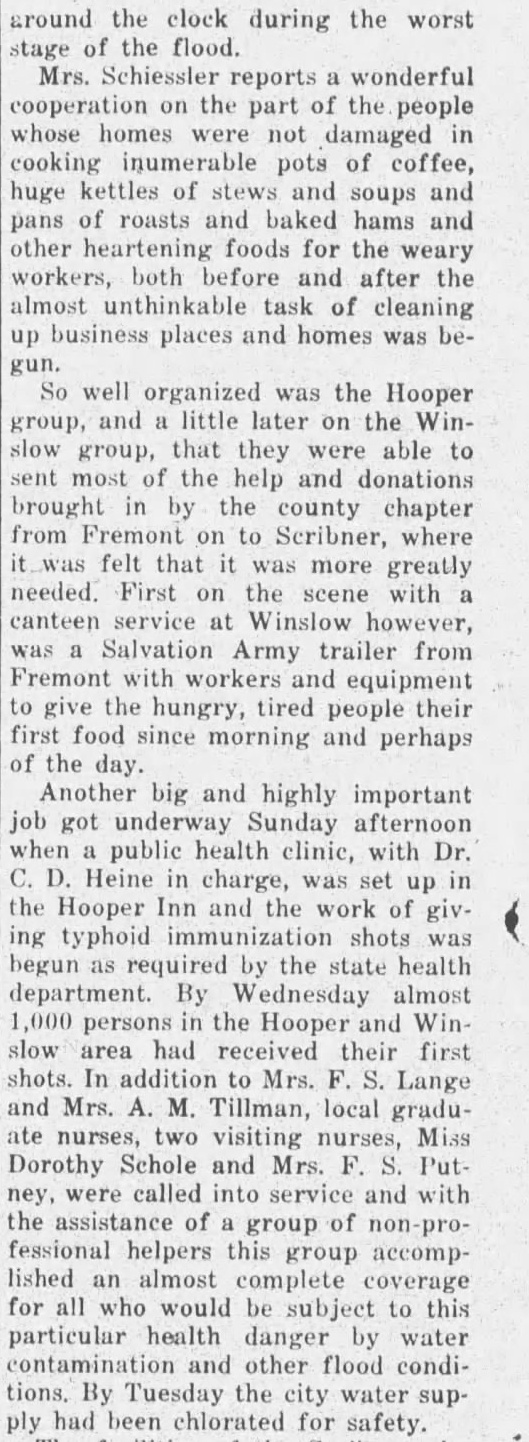
Before the flood reached Hooper, volunteers were already serving hot coffee and sandwiches at the Legion rooms. When the danger forced them to leave, the work moved into a wider relief effort. The June 15 Sentinel described a Red Cross canteen in the Pfeiffer garage near the hotel, feeding hundreds around the clock during the worst stage of the disaster. [B]
A garage becomes a canteen
The report credited canteen chairman Mollie Schiessler and Auxiliary chairman “Babe” Bott with organizing food service. It also credited residents whose homes had escaped damage. Their kitchens supplied coffee, stew, soup, roasts and baked ham for tired workers. This was relief built from places and people already familiar to the town: a garage, the Legion rooms and kitchens that could still function. [B]
The Sentinel described cooperation among the Hooper Township Red Cross, the American Legion and Auxiliary, the village board, fire department and commercial club. Mayor Roy Bott also served as civilian-defense chairman for the Hooper area. The account praised the speed with which these groups organized, but its larger picture is practical: meals, volunteers and local leadership had to keep working while homes and businesses were unusable. [B]
The Hooper Inn’s other emergency
A public-health clinic opened at the Hooper Inn on Sunday afternoon under Dr. C. D. Heine. The newspaper reported that by Wednesday nearly a thousand people in the Hooper and Winslow area had received first typhoid immunization shots. That figure covers both communities; it is not a count of Hooper residents alone. The report also said the city water supply had been chlorinated by Tuesday. [B]
The paper named local nurses Mrs. F. S. Lange and Mrs. A. M. Tillman, visiting nurses Dorothy Schole and Mrs. F. S. Putney, and nonprofessional helpers. Its continuation described Red Cross assistance records being assembled under Mrs. G. H. Harman. Alongside immediate care, someone was beginning the paperwork needed to help households recover. [B][C]
Neighboring towns, shared resources
The same account moves repeatedly between Hooper, Winslow and Scribner. It says much of the help brought by the county chapter from Fremont could be directed toward Scribner because the local groups at Hooper and, later, Winslow were functioning effectively. It also reports that facilities at Scribner air base sheltered stranded people and residents displaced from their homes. These were connected relief efforts across several communities, not events all located inside Hooper. [B]

For a history of the flood, these details matter as much as the dramatic arrival of the water. Feeding people repeatedly, finding usable buildings and recording requests for help were not single moments of rescue. They were work that had to continue from one shift and one meal to the next. The newspaper lets us see some of the people who carried it out.