
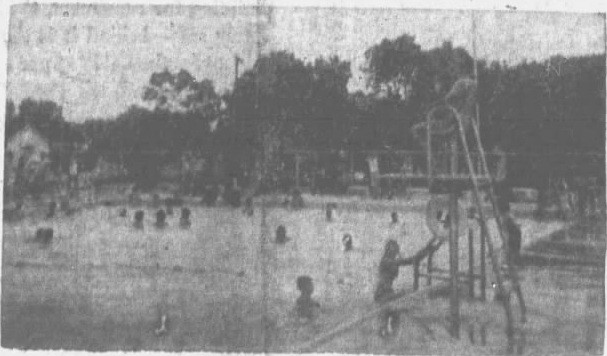
On July 4, 1964, Hooper’s new swimming pool opened with free admission. Children and adults crowded into the water while others came to watch. For Paul Peter, waiting an hour and a half at the entrance earned a small place in town history: the Sentinel identified him as the first official swimmer. The pool’s first afternoon was the visible result of years of donations, community benefits and decisions about where and how to build. [5]

A council formed to get things done
The effort began with a broader question about community improvement. In November 1959, the Hooper Woman’s Club recommended a council with representatives from civic, church and club organizations. The Community Council formed in June 1960 with sixteen member groups. Pastor Grant Van Boening of Redeemer Lutheran Church served as president, Howard Row as vice-president and Mrs. Harold Karl as secretary. Morris and Dorothy Payne of the Hooper Sentinel participated as nonvoting members and provided newspaper coverage. [1]
The council’s early work included mosquito spraying, civil-defense planning and summer recreation. It also arranged activities for young people, whose swimming lessons meant traveling to Scribner because Hooper had no pool. A local facility would give the council’s recreation work a permanent home and reduce the need to transport children elsewhere for instruction. [1]
By August 1961, the council voted to pursue a pool. Its committee included Richard Warne, Tony Steffen, Don Shaffer, Mrs. Morris Payne, Don Schwab and Bernard Havekost. The initial goal was $30,000, and pledges could be paid in weekly or monthly amounts through a bank account. The council supplied an early $330 toward the campaign. [1]
Fundraising became a town activity
A pool could not be built on the initial gift alone. Hooper used familiar forms of community entertainment to make the fund grow. Fun Frolic events brought people together for a local cause. The centennial account reports that the February 1961 event drew about 1,200 people. Nebraska Trail Days on June 14–15, 1962 attracted nearly 5,000 and netted about $5,100 for the effort. [1]
The 1962 flood interrupted the fundraising schedule: an event planned in March was postponed until April. The campaign nevertheless continued. Contributions also came from a public-health effort. In September, the Sentinel reported that $925.98 left from the Sabin oral polio program went into the swimming-pool fund, bringing its reported total to $28,195.77. Different community projects could support one another as expenses were settled and surplus money became available. [1], [3]
The first proposed site was not the final one
The August 30, 1962 Sentinel named School Park as the first choice for the pool and Memorial Park as the second. State health official T. A. Filipi’s advice was part of the discussion. Water and sewer connections already available at School Park were an advantage; connecting Memorial Park was then estimated to cost about $5,000. [2]

The final project went into Memorial Park. The centennial history places that decision in August 1963, when Bruce Gilmore and Associates of Columbus served as architects and Fauss Construction was the contractor. The Sampson house on the site was removed. Excavation began in November with volunteer dump trucks helping carry away dirt. The account also explains that a separate children’s pool was dropped as the project was adjusted to available money. [1]
The final location placed swimming alongside other community activities in the park. [1], [2], [6]
Water in the pool, but another bill to pay
The pool was filled on June 2, 1964. Filling it did not immediately mean opening it. The project was intended as a gift from the Community Council to the Village of Hooper, and the remaining expenses had to be met before the handover. A last round of fundraising came just as families could see the finished water waiting for them. [1], [5]
The Scribner Rustler promoted Hooper’s June 27–28, 1964 Trail Days benefit and reported that approximately $5,500 was still needed on a project then estimated at $43,500. The centennial account says that benefit netted $3,813.51. A final burst of gifts followed. The opening report in the July 9 Sentinel gave the completed cost as $41,800 and explicitly described it as raised through gifts and benefits, without a bond issue. The June estimate and July completed figure belong to different stages of the project. [1], [4], [5]
Opening day and the people at the bathhouse
The July 4 opening was free for everyone. The Sentinel described a busy pool, with swimmers of different ages and spectators watching from the side. Its pictures show the crowd in the water, the bathhouse staff and the first swimmer—three views of the same community achievement. [5]


The opening-day staff photograph names Betty Payne and Susan Ott as basket girls and Marsha Robley and Chuck Wagner as lifeguards. The caption also lists staff members absent from the picture: lifeguards Susan Schwab and Nancy Groeteke, and basket girls Sheila Ryan and Marilyn Schumacher. These names preserve the young workers who helped turn the new pool into a daily operation. [5]
Lessons were an immediate priority. The same issue announced free Red Cross swimming instruction beginning July 13, sponsored by the Hooper Township Chapter of the Red Cross. Children needed parental permission; a small bathhouse-fee arrangement was separate from the free instruction. The pool had opened for recreation, but teaching local children to swim was part of its purpose from the beginning. [5]
A lasting part of Memorial Park
Decades later, the state’s 2020 description of a Hooper park project still grouped the swimming pool with the auditorium, baseball field and basketball/pickleball courts as Memorial Park’s community facilities. That setting is the lasting result of the location choice made during the building campaign. [6]
Hooper’s pool story is therefore more than a construction date. It connects a council of sixteen organizations, trips to Scribner for lessons, benefit weekends, small recurring pledges and a final push to pay the bills. The opening photographs capture the moment those efforts became something residents could finally use.