Before Hooper could dance, gather or celebrate in its new auditorium, residents had to decide to build it—and then find a way to finish it. The project moved through rejected proposals, a successful bond vote, construction of the shell and another long campaign for the floor, heat, wiring and furnishings. Its dedication in November 1957 recognized a building made possible by public funding and many smaller contributions of money, materials and work. [1], [4], [7]
A memorial that would serve the living
The centennial history traces the idea to February 1946, when Hooper’s American War Dads proposed an auditorium as a war memorial. Representatives of interested organizations were to help develop the project. A useful gathering place could honor wartime service while meeting the town’s continuing needs. [1]
By March 1950, an auditorium bond proposal had reached the newspaper’s front page. A petition sought a public vote on a $60,000 project. The proposal did not succeed, and later efforts also met resistance. These early campaigns show that the auditorium was neither an instant consensus nor simply a building ordered and completed in one year. [1], [2]
A September 1953 community meeting brought together about sixty-five people to consider costs, with William Egger as chairman and Fred Ott as secretary. The committee studied other auditoriums. Residents were weighing the expense against the need for a place large enough for local events. [1]
Young people made their case
Students joined the discussion in 1954. The Sentinel published selected entries from an essay contest that attracted 130 submissions. The young writers described a need for school and social gatherings, performances, dinners and other community uses. Some connected the auditorium to visitors coming into town for activities and spending money at local businesses. Their arguments placed children’s activities and the town’s shared life in the middle of the debate. [3]
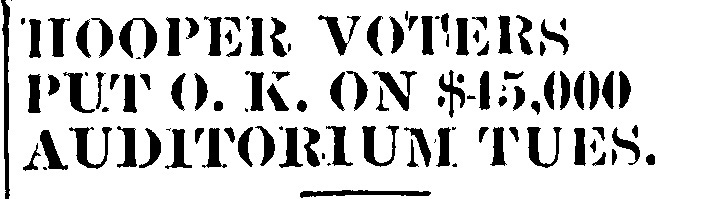
The decisive initial vote came November 2, 1954. In its November 4 report, the Sentinel recorded 258 votes in favor and 138 against the $45,000 auditorium proposal. The newspaper noted that the question had been defeated on three earlier occasions. Passing the bond issue was a turning point, but the amount approved did not cover every part of a finished and equipped hall. [4], [7]
The shell went up in 1955
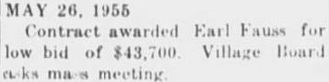
The newspaper’s chronology, published for the 1957 dedication, places the building contract in 1955. It lists Earl Fauss’s low bid of $43,700 under May 26 and records the contract being let under June 9. Between those entries, a community meeting agreed to proceed with a basic building contract that excluded wiring, plumbing, heating and flooring. Those necessities would require further funds. [7]
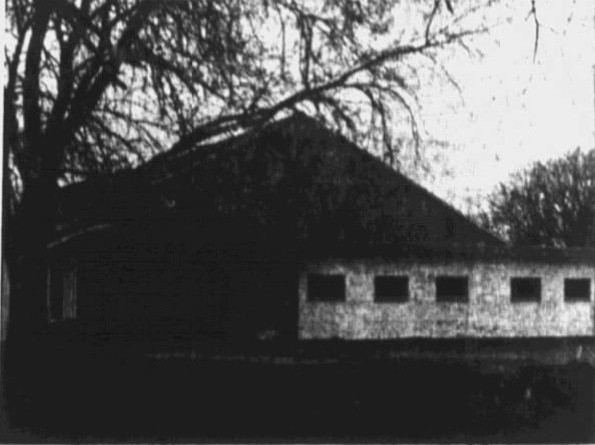
By November 1955, photographs showed the exterior standing and the high roof above an unfinished interior. The pictures are particularly useful because they distinguish a constructed shell from a completed auditorium. The lack of a finished floor was not a minor detail for a building intended to host dances, games and large gatherings. [5]
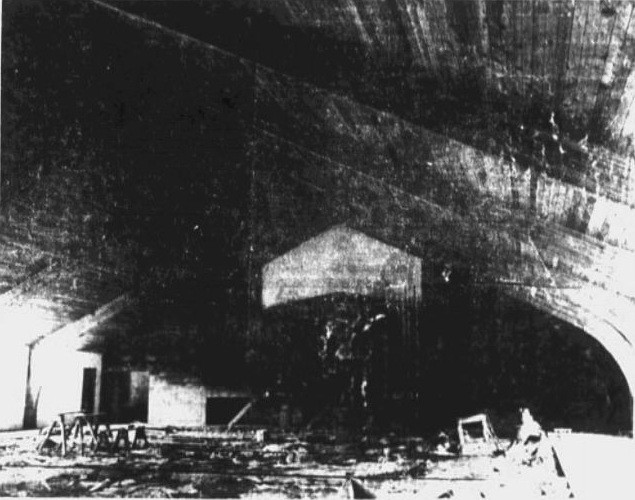
The town organized a second kind of building campaign, this time around finishing and furnishing the space. The Woman’s Club held a community sale for kitchen needs. Veterans’ groups, the Commercial Club, firemen, Lions and women’s organizations planned benefits and a rural fundraising drive. The chronology records more than $1,000 in receipts from a December 1955 Fun Frolic and later contributions from church groups, clubs and individuals. [1], [7]
What it took to finish the hall
Some contributions were cash; others became physical parts of the building. The centennial account credits Earl Fauss with constructing kitchen cupboards and Wollmer and Warne with flooring for the kitchen, hallway, meeting room and checkroom. Businesses and residents also supplied dishes, appliances, paint and chairs. A public facility needed more than its large central room to serve a dinner or a community program. [1]
Funding remained difficult. A $15,000 completion bond proposal failed in 1956; the contemporary chronology says it lost by eight votes. A new petition followed in March 1957. That spring, voters approved the completion issue, 285 to 95. The newspaper’s sequence also records an open house on March 31, before the later formal dedication, demonstrating that residents saw and used the project during its development. [7]
The chair drive continued into dedication week. The November 7 Sentinel listed 376 chairs toward a goal of 400, with recent gifts from named families and businesses. The list is a small but concrete reminder of how the last pieces arrived: a few chairs at a time, until the hall could welcome a crowd. [6]
Sunday’s ceremony, Monday’s dance
The printed dedication program gives a firm date and time: Sunday, November 10, 1957, at 3 p.m., in Memorial Park. The Hooper High School Band, directed by John Parde, provided music. Boy Scouts presented the colors, John Wollmer reviewed the auditorium’s history, and Norris W. Lallman, president of the Hooper Lions Club, introduced guests. John Shaffer, chairman of the village board, handled the dedication. School vocal groups and local clergy also participated. [6]
The Fremont Tribune preview described the Lions Club as taking charge of the ceremony and said organizations involved in planning and fundraising would be represented. The building was to remain open through Monday, with a free celebration dance Monday night. The ceremony and the dance were separate parts of the opening celebration: November 10 and November 11 respectively. [8]
A room that became part of community life
The work did not stop with the dedication. The centennial history records Lions Club dances supporting bleachers and a 1958 Commercial Club benefit for stage curtains. A hall becomes more useful as its furnishings and equipment catch up with the events people want to hold there. [1]
The state’s 2020 description of Memorial Park still identifies the city auditorium alongside the pool, ballfield and courts as part of an important community gathering place. The long campaign of the 1950s produced a shared setting within that park, where the purpose was broader than any single organization’s meeting. [9]