Hooper’s early band photographs are full of familiar local surnames, polished brass instruments and carefully arranged uniforms. On one bass drum, the words Silver Cornet Band identify the group. In other pictures, the musicians march uphill or perform outdoors on the bluffs. These were local people making music for a local audience, in a tradition that carried from an opera-house stage to summer evenings in the park. [1],[4],[6]
The musicians behind the town’s band
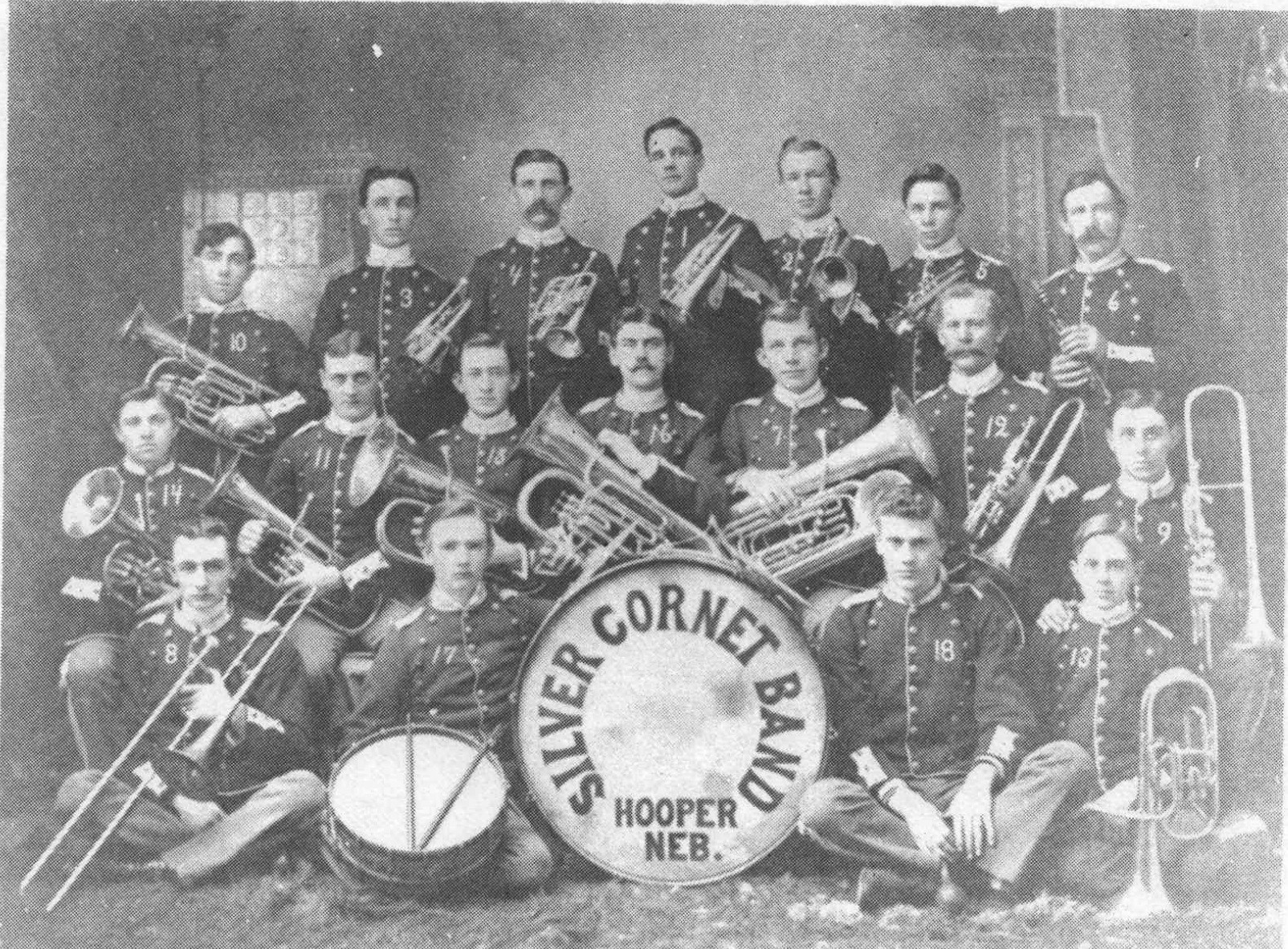
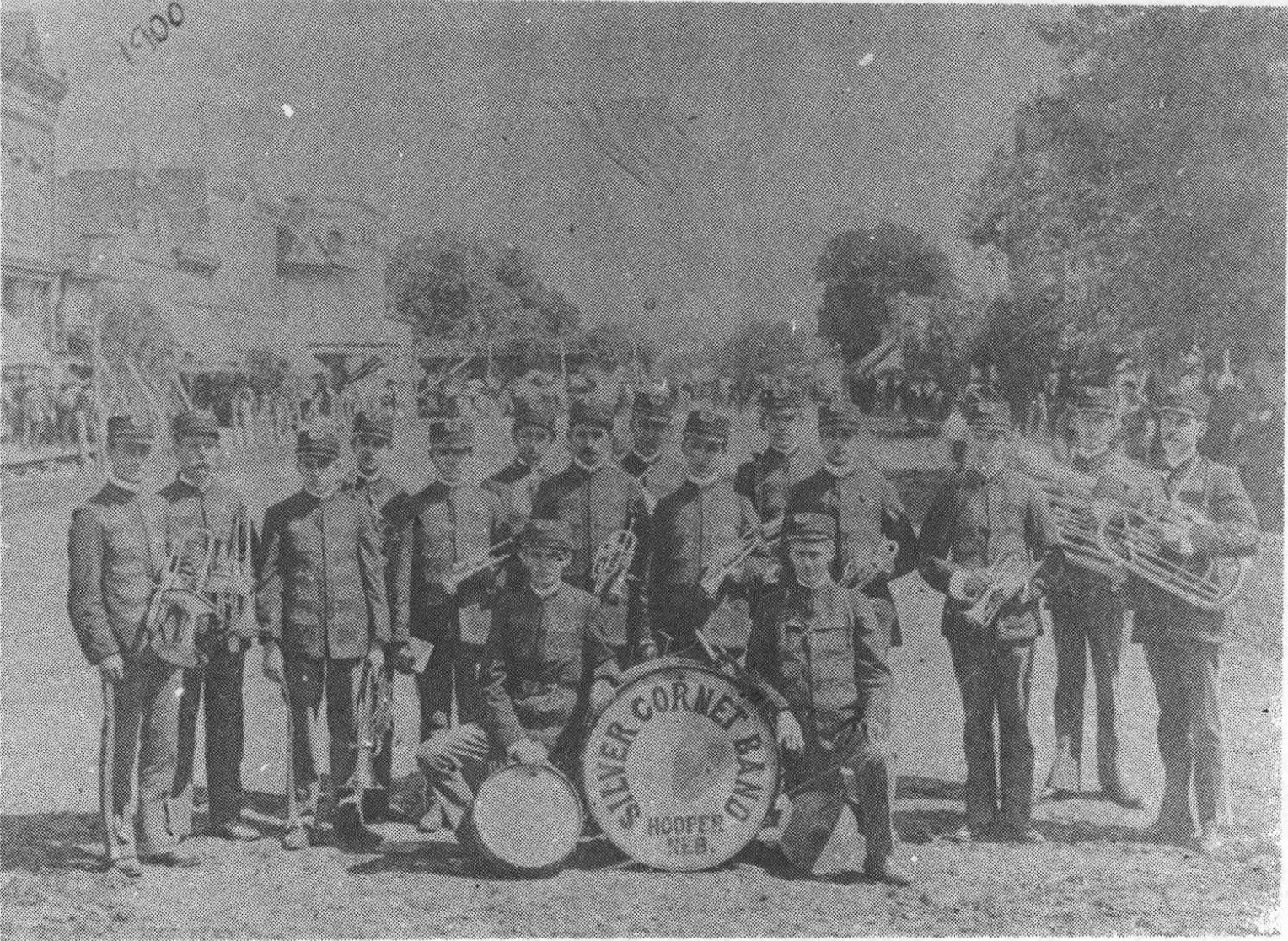
The centennial book preserves several early band portraits, including one dated 1900. Uniformed musicians pose with cornets, larger brass instruments and drums, ready to represent Hooper in public. [1]
The caption beneath the 1900 photograph identifies fourteen musicians, with surnames reproduced here as printed: H. T. Ring, Lloyd Denslow, John Heine, John Matzen, William Hecker, Ed Wrekhorst, Ernest Fritz, Louis Uehling, Henry Uehling, Howard Heine, Adolph Wiebel, Henry Buckholz, Arthur Jacobs and Ben Ott. The list places the band within Hooper’s families and businesses. These were people whom an audience might also encounter at work, in church or on Main Street. [1]
The photographs also show the practical size of the undertaking. A band required several kinds of instruments, percussion, coordinated dress and players willing to rehearse together. The group portraits preserve the members as individuals, while the parade and outdoor-performance pictures show what they did together for the town. [1]
A concert and a dance in February 1901
A surviving Sentinel advertisement supplies a precise evening to match the broader photographic record. The Hooper Cornet Band announced a concert and dance for Saturday, February 16, 1901, at the opera house. Doors were to open at 7:30 p.m., with the concert beginning at 8. The paper printed a seventeen-number program, giving readers a detailed preview of the performance. [4]
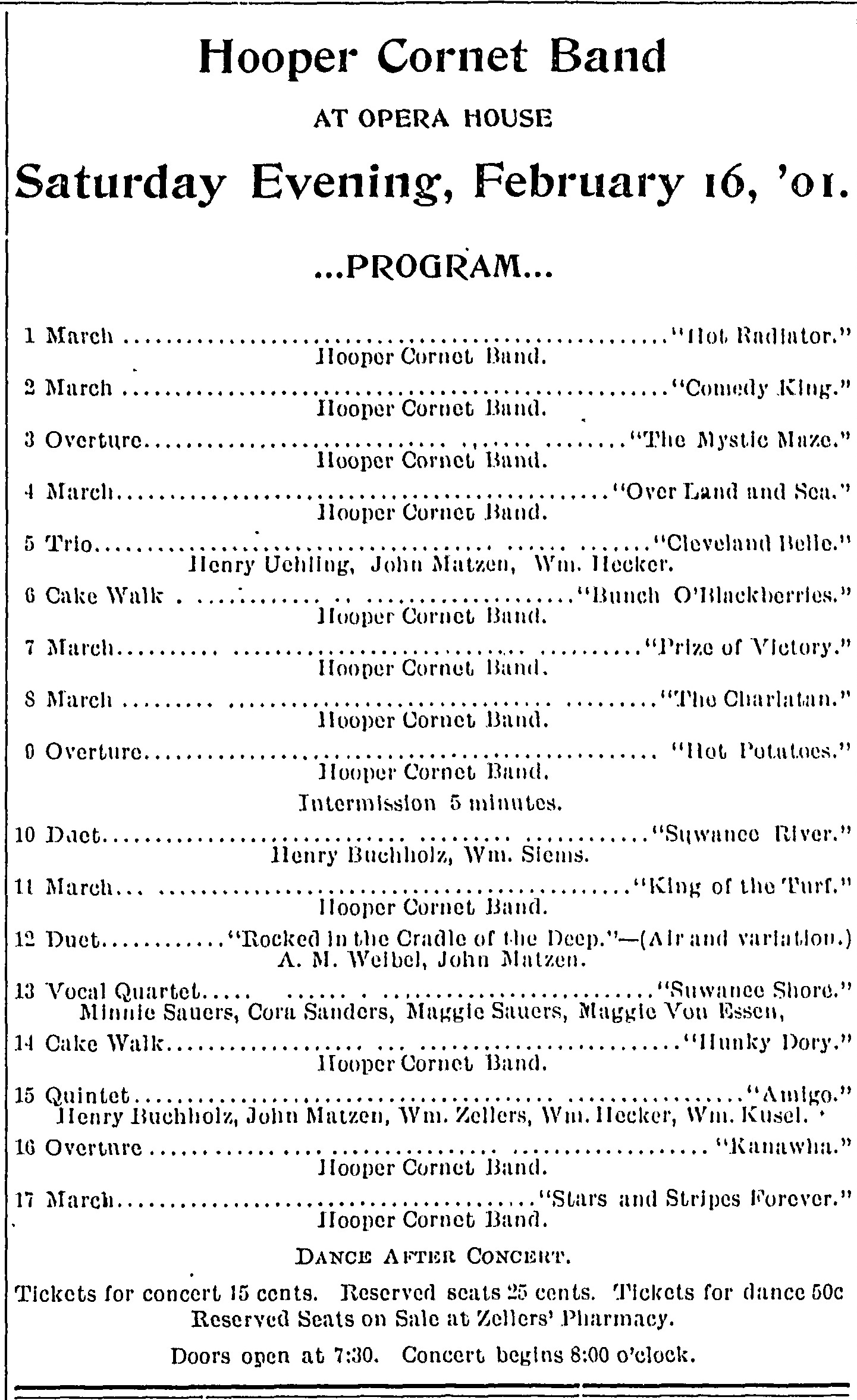
The selections mixed marches, overtures, a trio, vocal music and other arrangements. The printed finale was “The Stars and Stripes Forever.” Henry Uehling, John Matzen and William Hecker were named for the trio. The vocal quartet brought Minnie Sauers, Cora Saunders, Maggie Sauers and Maggie Von Essen into the program. The evening therefore included more than a continuous set by brass instruments alone. [4]
Admission was fifteen cents, with reserved seats at twenty-five cents. The dance cost fifty cents, and Zellers’ Pharmacy handled reserved seats. Those small details show the performance as a planned community occasion: there was a place to buy tickets, a scheduled opening, a published musical sequence and another activity after the concert. [4]
Music on the street, the bluffs and the stage
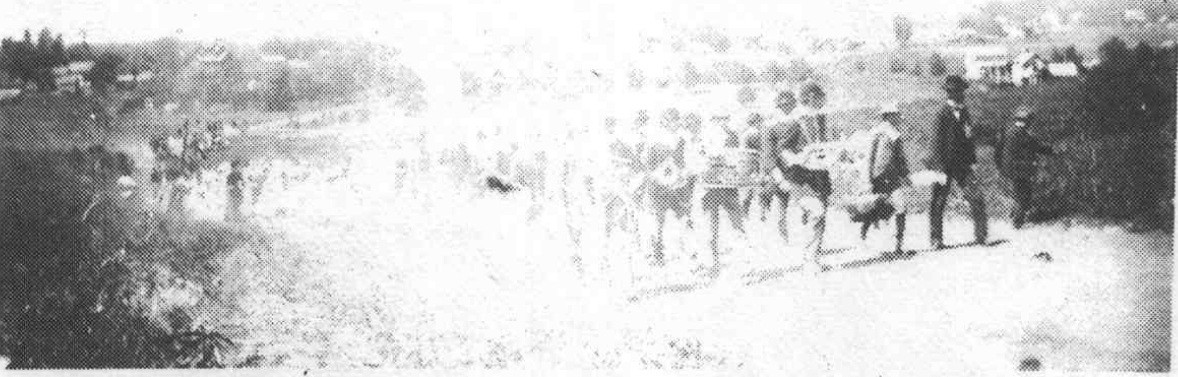
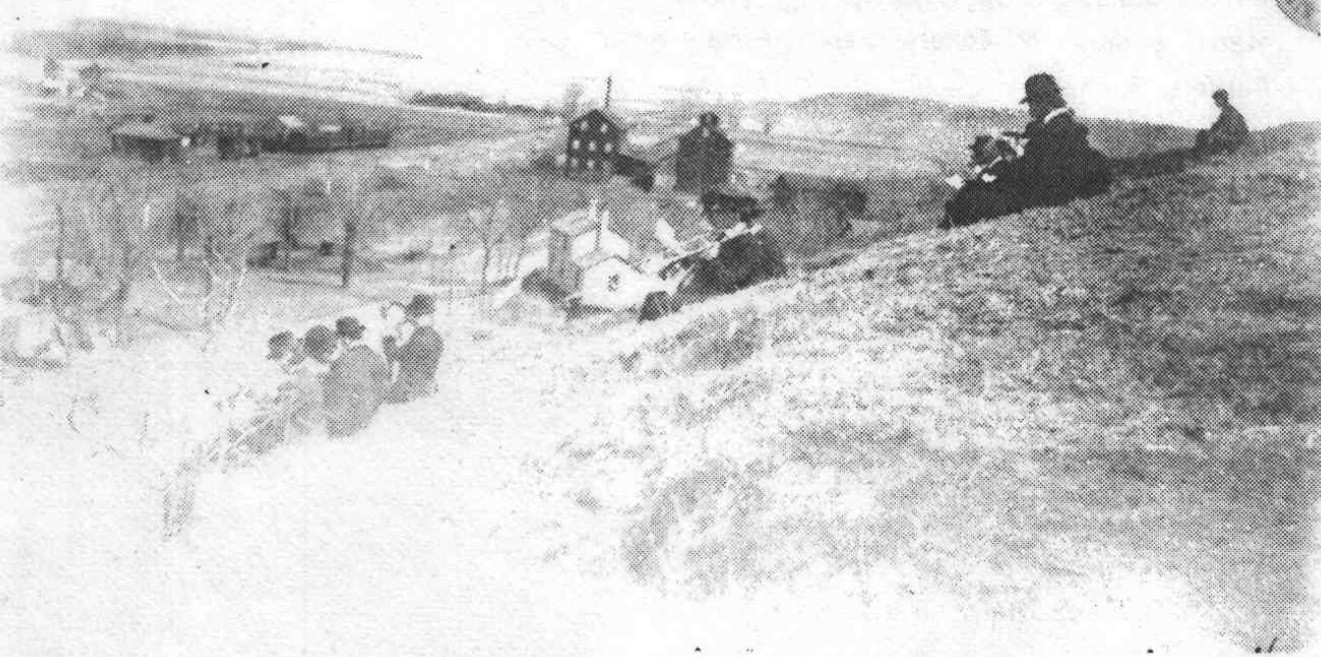
The band’s public life extended outside the concert hall. In one centennial photograph, the musicians climb a Hooper hill in formation. Another shows them playing on the bluffs. Both undated views place the musicians outdoors, carrying their instruments into settings that would have been familiar to residents. [1]
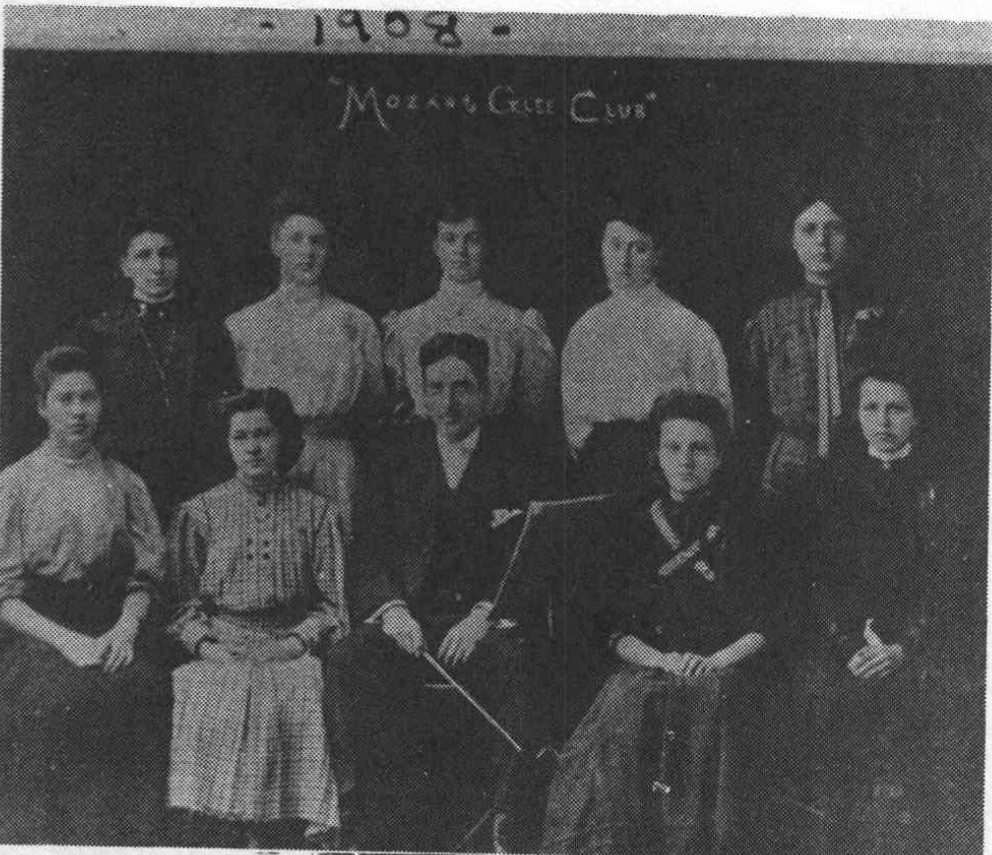
A separate photograph is marked “1908” and “Mozart Glee Club.” The centennial book describes it as one of Hooper’s early musical clubs and identifies its members. Its mixed group of women and men broadens the picture of local music beyond the uniformed band. Together with the vocal quartet in the 1901 program, it shows that Hooper’s musical life included organized singing as well as instrumental performance. [2],[4]
The glee-club caption names Lillian King, Barbara Harms, Alta Kirsch, Edith Heine and Alta Nelson in the top row. Charlotte Monnich, Mamie Hauser, Mr. Sloan, Jessie Snover and Lucy Jenssen appear in the bottom row. The picture gives these singers a place alongside the better-known instrumental groups in Hooper’s musical record. [1],[2],[3]
Teaching the next generation of musicians
The centennial history records a later connection between school instruction and public music. Paul C. Peterson came to Hooper as principal in 1927 and took charge of a band that began with twenty members. The account describes performances at holiday events and Dodge County fairs, with younger musicians eventually moving into the concert band. [3]
That progression helps explain how community music could continue beyond one photographed group. Young players learned together, appeared in public and then joined a wider ensemble. The book presents Peterson as an enthusiastic advocate for music’s place in community life. The documented organization and performances are the clearest evidence of his contribution. [3]
Summer concerts in the parks
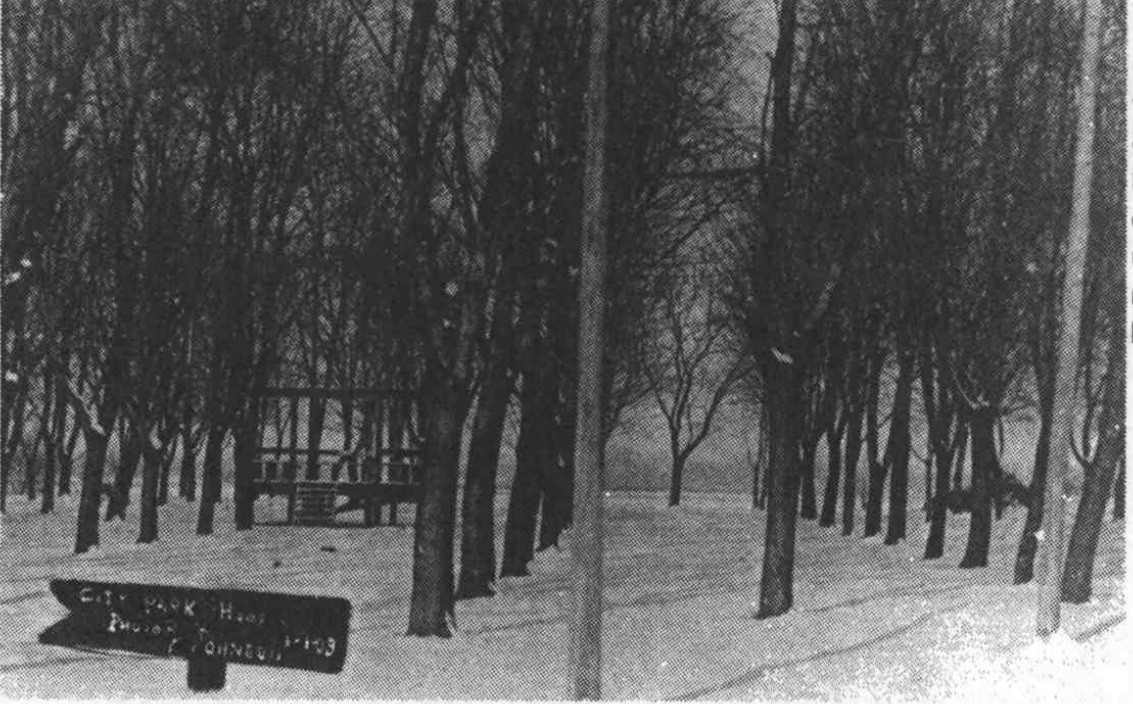
A photograph of Hooper City Park shows a wooded setting and a grandstand that the book identifies with summer concerts. Its date is not supplied. The view offers a different setting from the formal portraits: music belonged among the town’s trees and gathering places as well as inside a hall. [2]
In 1958, the Sentinel advertised Wednesday-evening band concerts at Memorial Park, beginning at 8 p.m. and continuing through August. Its July 31 notice placed the concerts alongside the town’s evening routines, including stores closing on Wednesdays and the possibility of baseball after the music. [5]
The August 14 issue then reported that a fairly large audience had attended the band’s first concert at Memorial Park. The park provided another setting for a musical tradition already documented more than half a century earlier. The report also noted that ball games had been called off for the evening. [4],[6]

Across these records, Hooper’s band appears as both a performing group and an organizer of shared time. Residents could buy seats for a winter concert, follow musicians in a parade, hear them on the bluffs or gather for a Wednesday evening in the park. The surviving program and photographs allow that history to be seen in detail, with the musicians and their audiences placed back into the life of the town. [1],[2],[4],[5],[6]