For decades, autumn in Hooper meant a fair. Farm animals, exhibits, merchants and entertainment brought people into town for an event that had started modestly in 1906.
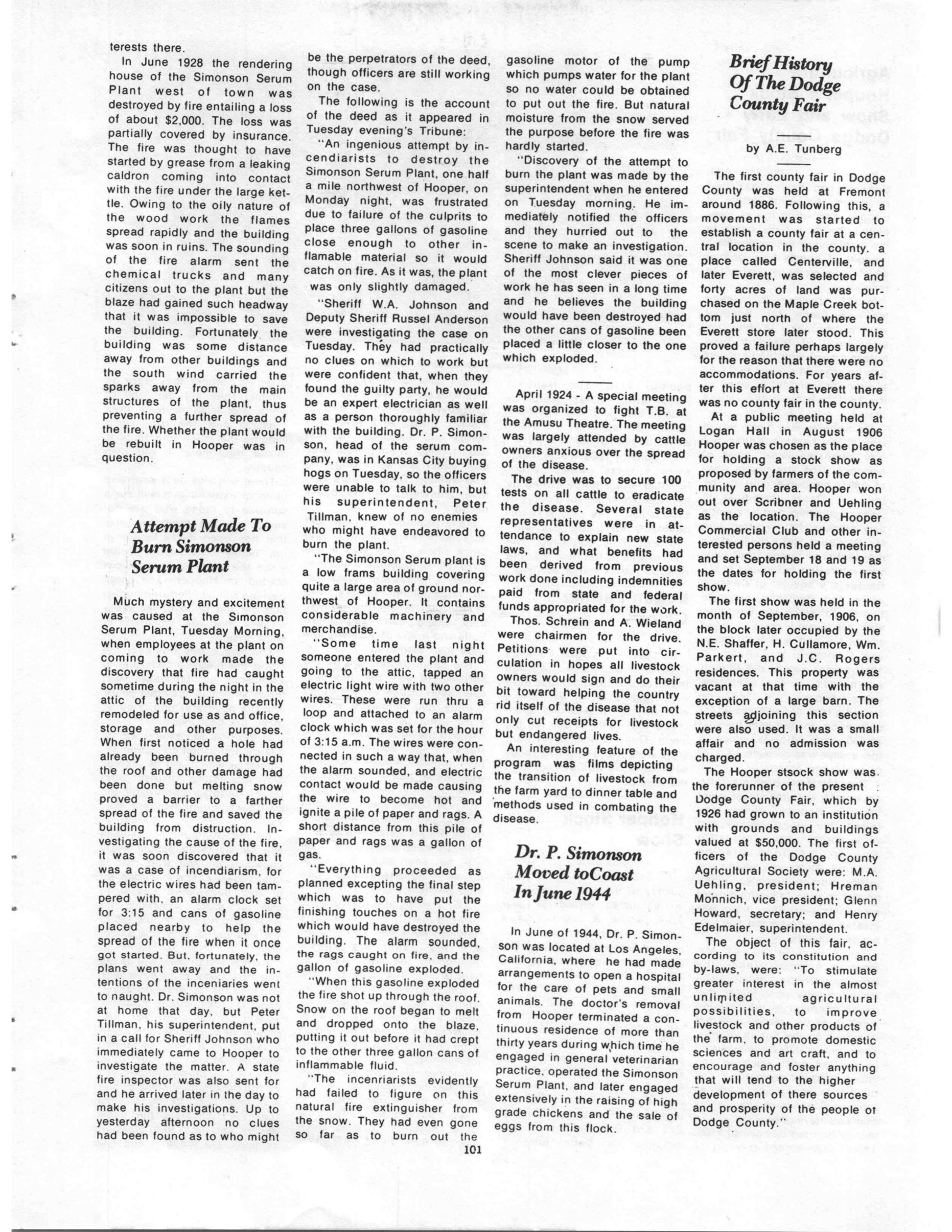
Its beginnings were far smaller than the fairgrounds remembered in later photographs. A. E. Tunberg’s “Brief History of the Dodge County Fair,” preserved in Hooper’s centennial book, describes the first show on a mostly vacant block with one large barn. Organizers used the adjoining streets, too. Admission was free. [Centennial History, p. 101]
A stock show finds a home
According to Tunberg, a public meeting at Logan Hall in August 1906 chose Hooper as the site for a stock show proposed by farmers in the surrounding area. Scribner and Uehling were also considered. The Hooper Commercial Club and other interested residents then set September 18 and 19 for the first show.
The purpose extended beyond an afternoon out. The fair’s stated aims included improving livestock and other farm products, encouraging domestic sciences and crafts, and helping develop Dodge County’s resources. Tunberg identifies that small 1906 stock show as the forerunner of the larger county fair and reports that its grounds and buildings were valued at $50,000 by 1926. [Centennial History, p. 101]

Two fairs on the 1911 calendar
The entertainment trade paper The Billboard gives us a dated glimpse between the first stock show and the later expansion. Its August 5, 1911 fair calendar listed Hooper’s Dodge County Fair for September 19–22, with J. H. Heine as secretary. On the same page, Scribner’s Dodge County Fair was scheduled for September 13–15. These were advertised dates, but the separate entries show that the two towns were promoting distinct events decades before the 1939 consolidation.[3]


Merchants, music and a dance pavilion
The centennial history’s account of the 1919 fair gives a sense of how much the event had grown. It calls that year the fourteenth annual fair and stock show. The grounds had gained five acres, hog-barn space had doubled, cattle-exhibit space had expanded, and a sales arena had been added.
A new merchants’ exhibit area offered booths for local businesses. The book calls it “Merchants Row” and says every business in town had a booth. The new dance pavilion was another attraction: it had hosted dances during the summer, and an orchestra dance was scheduled for each of the fair’s four nights. [Centennial History, p. 105]
On the preceding page, the book records the pavilion’s first dance on June 14, 1919, with 216 tickets sold. Together, these details show how the grounds served both agriculture and the town’s social life. [Centennial History, p. 104]
The pavilion’s entertainment appears in the original newspaper too. An advertisement published April 15, 1920 announced a dance for the following Thursday, April 22, with DeFord’s Jazz Phiends of Lincoln. Tickets were $1, plus war tax. It is a record of the advertised attraction and price, rather than a review of the performance.[4]

Why the two fairs consolidated
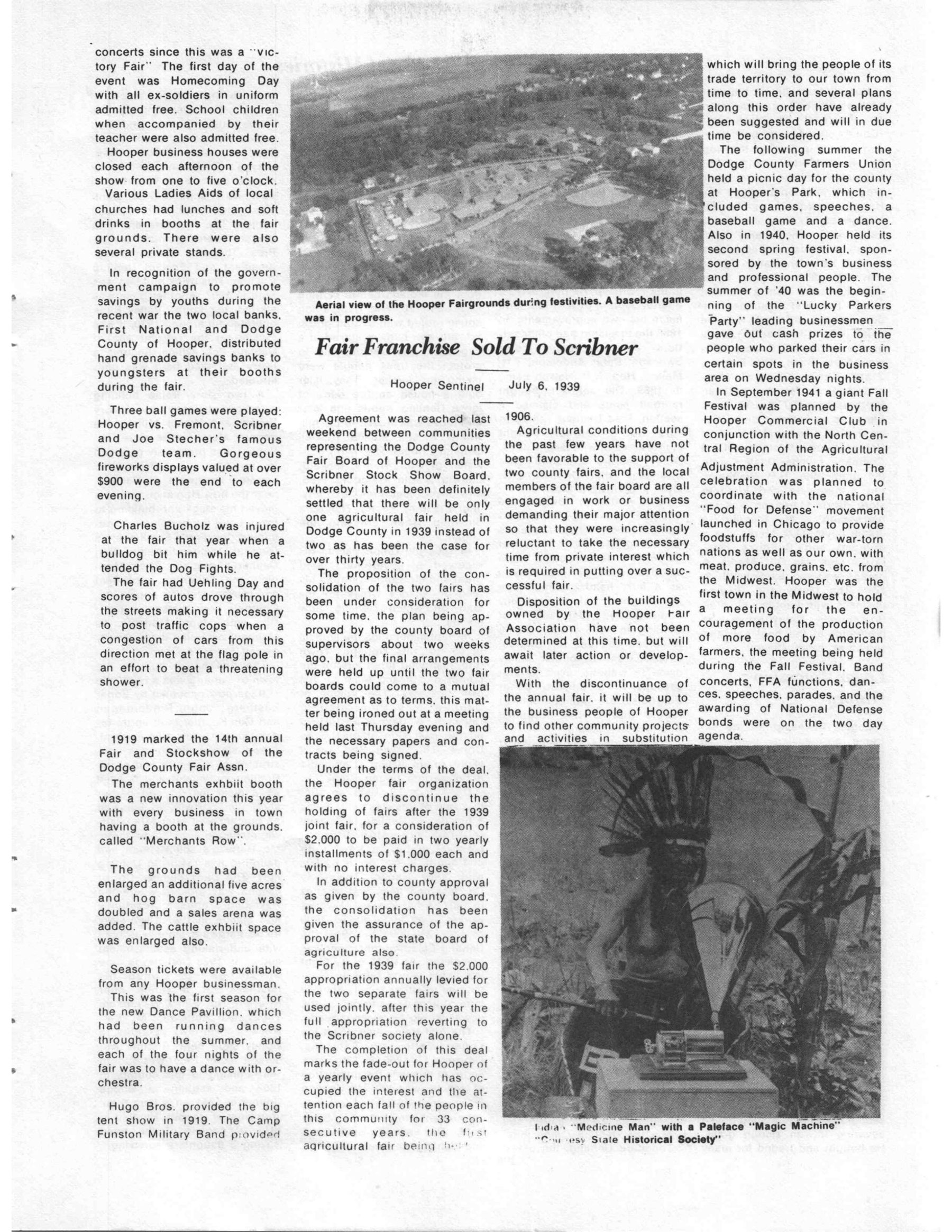
On July 6, 1939, the Hooper Sentinel announced an agreement between Hooper’s Dodge County Fair Board and the Scribner Stock Show Board. Instead of two agricultural fairs in the county that year, there would be one joint fair. The newspaper described this as the close of a Hooper tradition that had run for 33 consecutive years. [Sentinel, July 6, 1939, p. 1]
The agreement, also reproduced in the centennial book, called for Hooper’s organization to stop holding fairs after the joint 1939 event. It would receive $2,000 in two annual payments of $1,000, without interest. The annual $2,000 county appropriation previously supporting the two fairs would be used jointly in 1939 and would go entirely to the Scribner society afterward. [Centennial History, p. 105]
The report gave practical reasons: agricultural conditions had made two county fairs difficult to support, while Hooper board members’ work and businesses left them less time for organizing. It also said the future of the Hooper association’s buildings had not yet been decided. The agreement concerned the fair organizations and future events; it should not be read as a report that all the buildings moved to Scribner.
What came next for Hooper
The 1939 account looked to Hooper’s business community for other projects that would bring people into town. The centennial book follows it with examples: a county Farmers Union picnic at Hooper’s park the next summer, with games, speeches, baseball and a dance; and a second spring festival in 1940, sponsored by the town’s business and professional people. [Centennial History, p. 105]
The fair’s history gives those later gatherings a longer background. Before the consolidation, Hooper residents had spent a generation building grounds, arranging exhibits, supporting livestock shows and making room for neighbors to gather.
Read the records: The July 6, 1939 Sentinel front page carries the original “Fair Franchise Sold to Scribner” report. The supplied centennial book preserves it on printed page 105, alongside the later community-event accounts.
Photo note: The listing photograph shows Hooper’s stock-show pavilion and bears photographer Guy W. Johnson’s credit. It appears on printed page 104 without a photograph date. The other images are dated only where the book provides a date.
Does your family have fair ribbons, premium lists, programs or photographs from Hooper’s fairgrounds? Share them with the Hooper History Project. Please include any names and dates you know.