St. John’s Ridgeley lost its 1893 church building in November 1993. A replacement was dedicated in December 1994. Yet part of the congregation’s earlier history survives in a different form: a copied register in Nebraska’s state archives.[1]
A dedication notice from 1893
A small newspaper notice adds a date to the building’s beginnings. The Eastern Nebraska Genealogical Society’s October 2016 newsletter transcribes a September 8, 1893 Fremont World Herald item announcing the new German Lutheran church at Ridgeley’s dedication for the following Sunday. The notice is an advance announcement, preserved here through the society’s transcription; the original newspaper page has not yet been checked. It fits the state archive’s 1893 construction year without establishing the ceremony’s eventual outcome.[4][1]
A connection to Hooper
Pastors from Hooper’s Zion Lutheran Church served the Scribner-area congregation from 1929 to 1941, connecting the two communities long before the fire.[1]
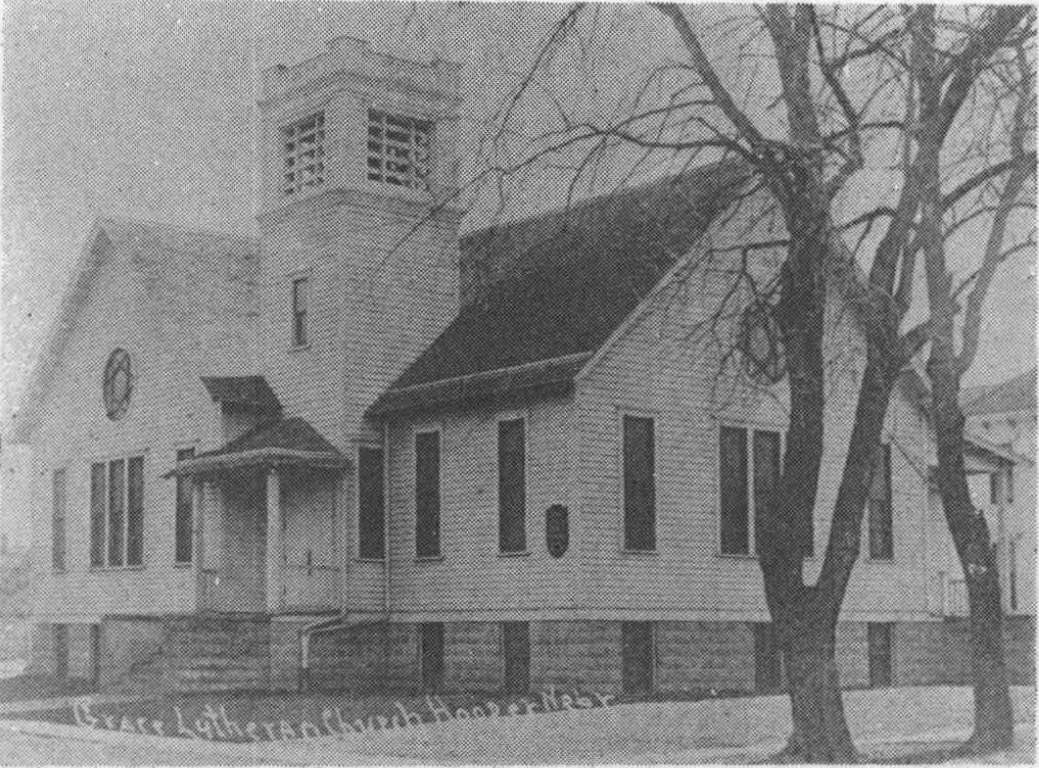
In 1958, Zion and Grace Lutheran congregations in Hooper merged to form Redeemer Lutheran Church. The centennial history records Redeemer’s first service in May 1958 in the former Grace church, pictured here.[3]
A record beyond the building
The Nebraska State Historical Society lists a photocopied register covering 1874–1941, with baptisms, marriages and communions. Entries were written in German until 1919. This article uses the archive’s description; individual register entries have not been examined.[1]
A dated family document might now help a researcher locate an entry in that register. A marriage certificate, for example, provides a name and date to compare; a labeled confirmation photograph may supply a different starting point. The next step is to look for agreement between the family record and the church’s own pages.
Other congregations left trails, too
A separate state collection traces a congregation from Pebble to Scribner. The Congregational Church of Pebble organized in J. B. Robinson’s home on December 28, 1871. It moved to Scribner in 1876, meeting in Meyer’s hall before acquiring its own building in 1882. Its records are cataloged under the United Church of Christ.[2]
That microfilm collection covers 1871–1974 and includes membership, meeting and ceremony records. The inventory identifies funerals in some volumes and deaths in others. It is a useful reminder that a family’s records may sit under a later congregation’s name, even when an old document names an earlier place.[2]
Do you have a dated photograph of Ridgeley’s old church or a program from the 1994 dedication? Share a copy with Celebrate Hooper. Identified pictures and documents can help tell this neighboring congregation’s story without losing the names, places and dates that make it its own.