The barn was an airplane hangar. The silo concealed its sliding doors. A building dressed as a church had a steeple, and a make-believe schoolyard had children made from chicken wire.
That is how Hooper’s 1976 centennial history describes the disguise at Scribner Air Base during World War II. The installation was built to train military aviators, but it also became an experiment in making an airfield look like the countryside around it. For Hooper, the story reached beyond military ingenuity. It involved farms taken for construction, a shortage of housing, neighbors helping servicemen settle in, and families who later made homes in the old barracks. [1, pp. 92–93]
The war reaches the farms
The centennial book dates the first official news of the project to October 1, 1942. Construction was expected to cost no more than $2 million, and the contract went to Fox Valley Construction of Appleton, Wisconsin. Within weeks, the account turns from a construction announcement to the consequences for people already living and farming there. [1, p. 92]
On October 8, farmers were salvaging corn for immediate feed because it was not yet ripe enough to store. An October 15 entry says government eviction notices had been issued before land appraisals had begun. By October 29, condemnation proceedings were pending to acquire 2,060 acres. Among the people named in the book are Frank J. Reyzlik, Henry Burnheide, Sophia M. Knieriem, Marie C. Mohr, Elsa Fisher, Frieda Nast and A. J. Von-Seggern. Those names make the cost of the project local and personal: the land needed for a new military installation was already someone’s farm. [1, p. 92]
The work moved quickly. An October 22 entry called for 350 workers at sixty cents an hour, with gravel hauling continuing around the clock. The book also records a housing shortage in Hooper as another appeal went out for labor. [1, p. 92]
An airfield made to look ordinary
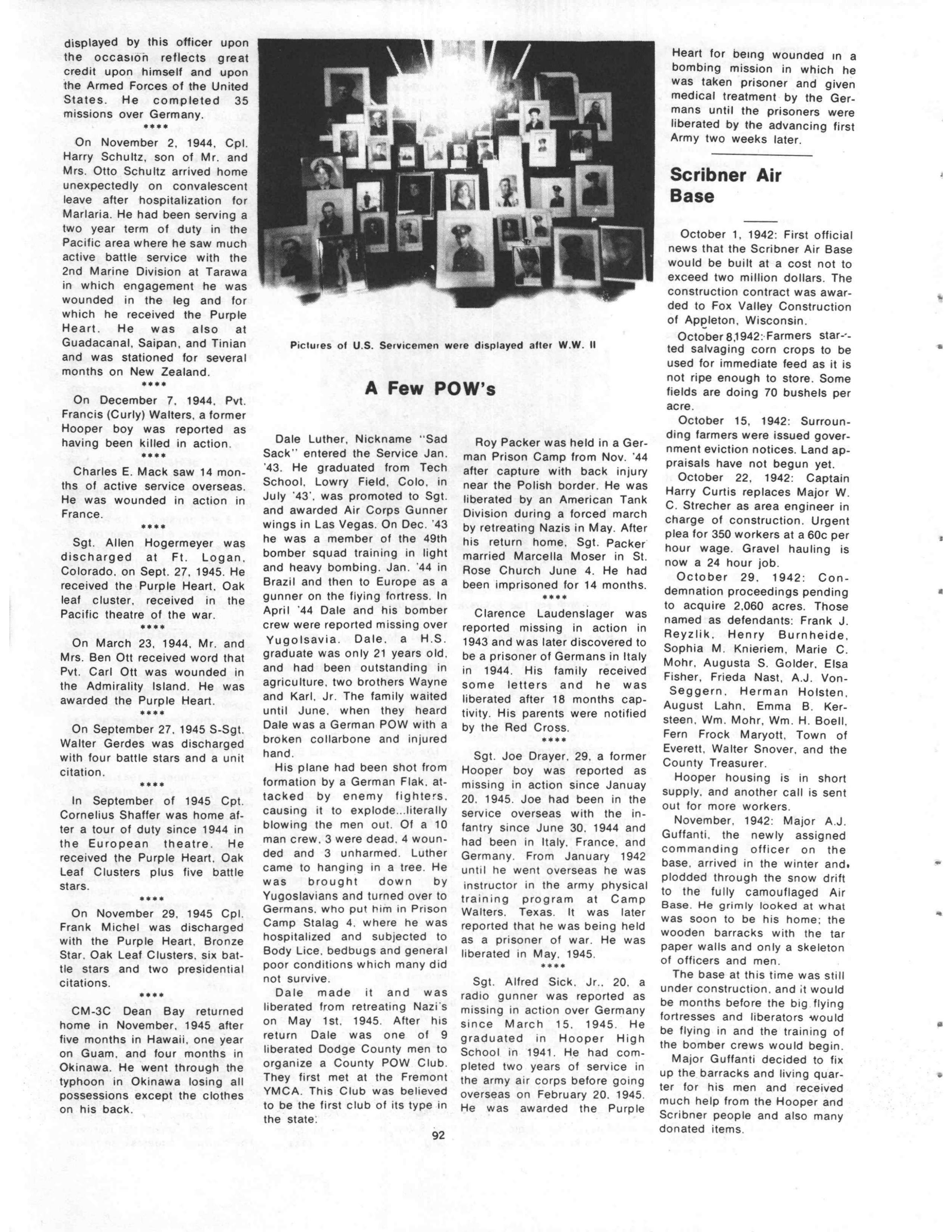
By November 26, according to the book, two runways were finished and a third was under construction. The flight tower was complete. Fifteen barracks, officers’ quarters, a post exchange and a hospital annex were also finished, while work continued on the large hangar. The field was to serve as a satellite of the main base at Sioux City. [1, p. 93]
The camouflage gave those military buildings a second identity. The hangar was painted red to resemble a barn; a mock silo concealed the hangar doors. Chicken wire filled with colored spun glass suggested trees. One building received a steeple and white paint, while the imitation schoolhouse had playground equipment and artificial children. Hundreds of cottonwoods were brought from the Elkhorn Valley for landscaping. [1, p. 93]
Even the runways were part of the illusion. The centennial account describes tar, wood chips and ground corncobs, with green coloring for summer and brown for autumn. It says pilots traveling between Lincoln and Sioux City had difficulty finding the disguised base even when they were looking for it. That last detail is an anecdote preserved by the local history, rather than a flight-test result established here from military records. [1, p. 93]
The broad camouflage story has support beyond the centennial book. Historian Robert Hurst’s 1995 review of Nebraska’s Army airfields describes Scribner as a site of extensive camouflage experimentation, with buildings made to resemble rural structures and repainted as the seasons changed. Hurst also identifies training there in B-17 and B-24 bombers and P-47 fighters. [2, p. 133]
Hooper helps its new neighbors
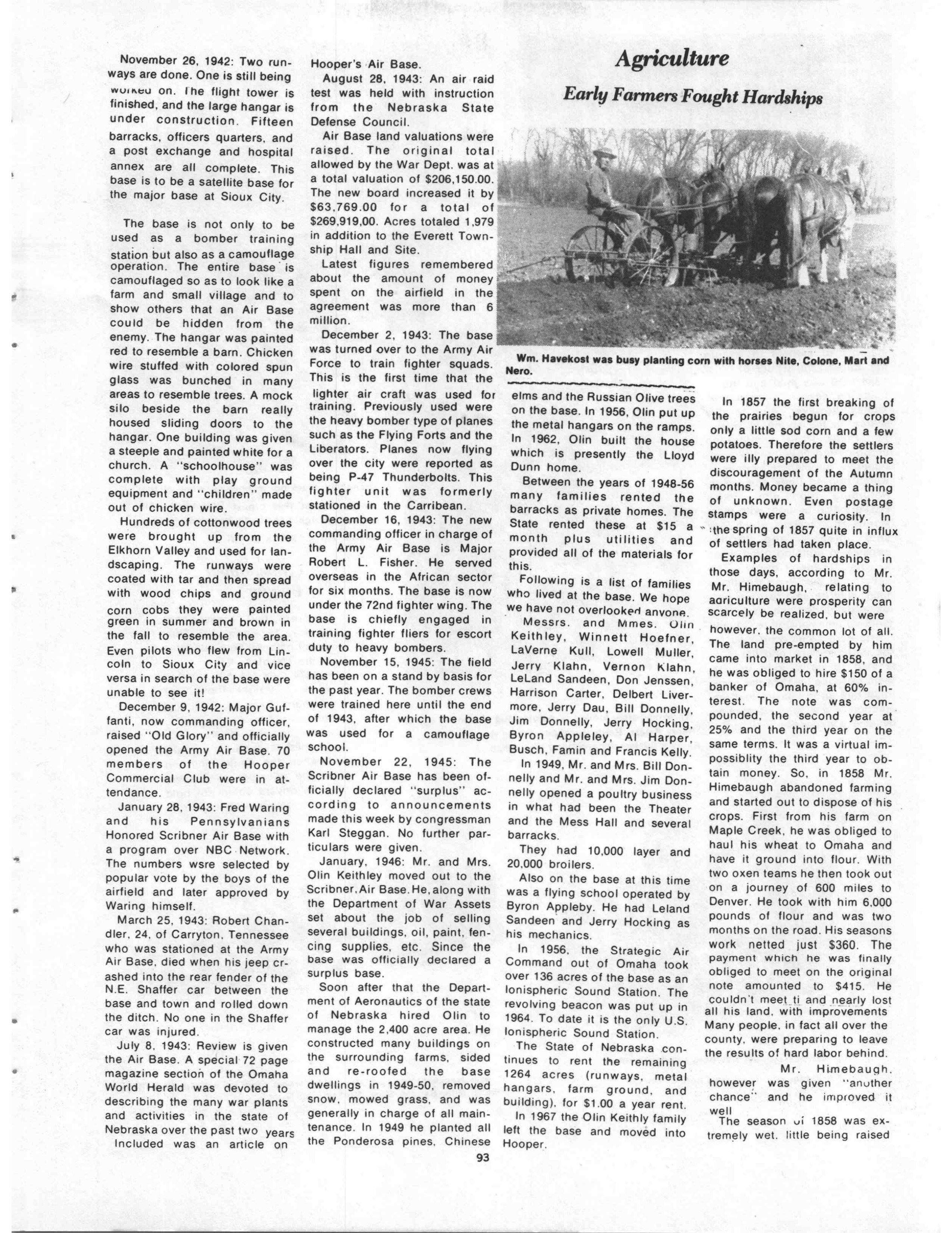
The centennial account describes newly assigned commanding officer Major A. J. Guffanti arriving amid snow and finding wooden barracks with tar-paper walls. Residents of Hooper and Scribner helped him improve the living quarters and donated items for the men. When the base officially opened on December 9, 1942, seventy members of the Hooper Commercial Club attended. [1, pp. 92–93]
The installation received a different kind of welcome on January 28, 1943. Fred Waring and His Pennsylvanians honored Scribner Air Base in an NBC broadcast. According to the book, the musical selections came from a popular vote among the men at the field, with Waring’s approval. [1, p. 93]
A changing mission—and an incomplete timeline
The book’s December 1943 entries describe a change from heavy-bomber training to fighter training. P-47 Thunderbolts were reported overhead, and the December 16 entry says the base was chiefly training fighter pilots for escort duty with heavy bombers. [1, p. 93]
A later entry, dated November 15, 1945, compresses the sequence differently: bomber crews trained until the end of 1943, after which the field served as a camouflage school. It also says the field had been on standby for the preceding year. Because that summary does not fully explain the fighter-training entries, the precise sequence and overlap of its missions remain a question for further research. Both the local history and Hurst’s account support the larger picture of an airfield used for aviation training and camouflage work. [1, p. 93] [2, p. 133]
When the barracks became homes
The centennial book records the field’s declaration as surplus on November 22, 1945. In January 1946, Olin Keithley and his wife moved to the base, where he helped sell surplus buildings and supplies. The state’s Department of Aeronautics later hired him to manage the property. [1, p. 93]
Between 1948 and 1956, families rented the former barracks for fifteen dollars a month plus utilities. The book names residents including the Keithleys, LaVerne Kull, Lowell Muller, Jerry and Vernon Klahn, and Bill and Jim Donnelly. In 1949, the Donnelly families opened a poultry business using the former theater, mess hall and several barracks. A flying school operated there as well. Buildings put up for wartime service had become places to live and earn a living. [1, p. 93]
For Hooper, that is what gives the air-base story its lasting place in the town’s history. The camouflage is memorable, but so are the interrupted harvests, the search for housing, the donated furnishings and the families who stayed after the military mission ended. Across two pages, the centennial book preserves those connections—and leaves room for residents’ photographs and records to tell us more.
Did someone in your family work at Scribner Air Base, help furnish its quarters or live in the barracks afterward? Share your photographs, letters or memories with the Hooper History Project. Dates, names and original captions can help us connect family stories with the written record.
Historical notes
About the record: The centennial book was compiled in 1976. Its dated entries are cited here as the book’s account, not as newspaper issues or military records independently inspected for this article. It gives different acreage totals for different stages of the property’s history; the 2,060 acres above refers specifically to the October 1942 condemnation entry. The camouflage details and the anecdote about pilots failing to locate the field are attributed to the book. Image captures retain the original scan appearance; only their boundaries have been cropped.