In 1882, Pebble had a post office, a school serving about forty-five pupils, a store, a blacksmith shop and a gristmill. By 1921, a county history placed it beneath the heading “Village of Pebble—Defunct.” Between those descriptions lies the story of a small Dodge County settlement whose hopes for a railroad were overtaken by neighboring Scribner.[1][2]
Pebble belongs to the history of places that gradually lost their role as towns. Its decline was not a single night's catastrophe. The earlier account shows people still living, learning, trading and milling there after Scribner had begun to grow.
A settlement around the mill
The Robinson family appears at the center of Pebble's story. Andreas's 1882 history describes a sawmill built by J.B. and H.J. Robinson in 1868, followed by a gristmill in 1869. The sawmill helped supply the work of constructing the later mill. Timber, water power and grain gave the settlement practical reasons to exist before a railway determined which nearby place would grow fastest.[1]
Pebble was surveyed and platted in 1870. The histories disagree about the precise date, so the year is the sounder starting point. The 1921 county history locates the town in section 36, township 20, range 6 east, and describes its proprietors' unsuccessful effort to secure the railroad. Scribner obtained the advantage they wanted.[1][2]
The railroad changed the balance
Andreas's account says Scribner soon outgrew Pebble. Yet its inventory of Pebble's school and businesses makes clear that the older settlement continued functioning. A railway could change a town's prospects without immediately emptying its homes or closing every business.[1]
The mill's history continued as well. The 1921 account describes an additional pair of grinding stones in 1871 and a new plant in 1886. It places the mill roughly a mile and a quarter from Scribner and says it was no longer operating by the time of writing. Those details describe a business that lasted beyond the town's early disappointment.[2]
This is also why Pebble should not be described simply as an earlier name for Scribner. The histories describe neighboring settlements with different locations and different fortunes. People and institutions moved between them; that is more revealing than treating the names as interchangeable.
The Witt brothers’ milling years
The same county history’s biographical volume adds the people behind the later mill. It says Henry Witt joined his brother John in operating the Pebble Roller Mills and that their partnership lasted ten years. Afterward, Henry returned to farming; by the time of the account, his home stood at the old Pebble townsite in section 36. The profile does not supply the partnership’s exact beginning and ending dates. It does show that the mill remained part of a working rural economy long after the railroad decision.[4]
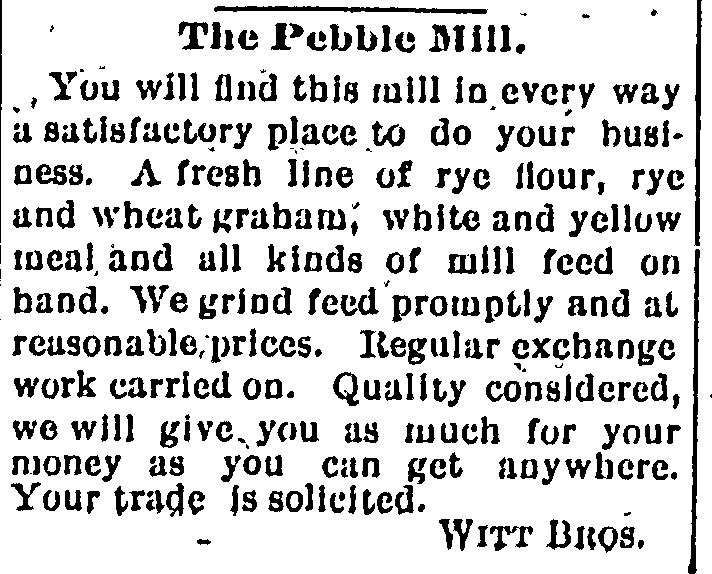
Their own advertising puts a date and a product list to that work. On September 1, 1905, Witt Bros. offered rye flour, rye and wheat graham, white and yellow meal, mill feed and feed grinding at Pebble Mill. A separate notice on the same page reported that they were taking down the old Robinson house at the mill and replacing it with a new structure. The report concerns the house, not demolition of the mill.[5]
A congregation carried part of Pebble with it
One connection survives particularly clearly. On December 28, 1871, a group met in J.B. Robinson's Pebble home to organize a Congregational church. Services took place in the schoolhouse for about five years. In 1876, the congregation moved to Scribner, where it worshiped in Meyer's hall before obtaining its own church building in 1882.[3]
The congregation moved; the archival account does not describe a church building being hauled from Pebble. That distinction matters because the schoolhouse had been its meeting place.
The Nebraska State Historical Society catalogs the later Scribner congregation's records, including a volume covering 1871–1880 with church history, members' names and meeting minutes. We have consulted the collection description, rather than the individual manuscript entries. Even so, it identifies a concrete place to continue learning about people whose town faded from prominence.[3]
Marking a town that had faded
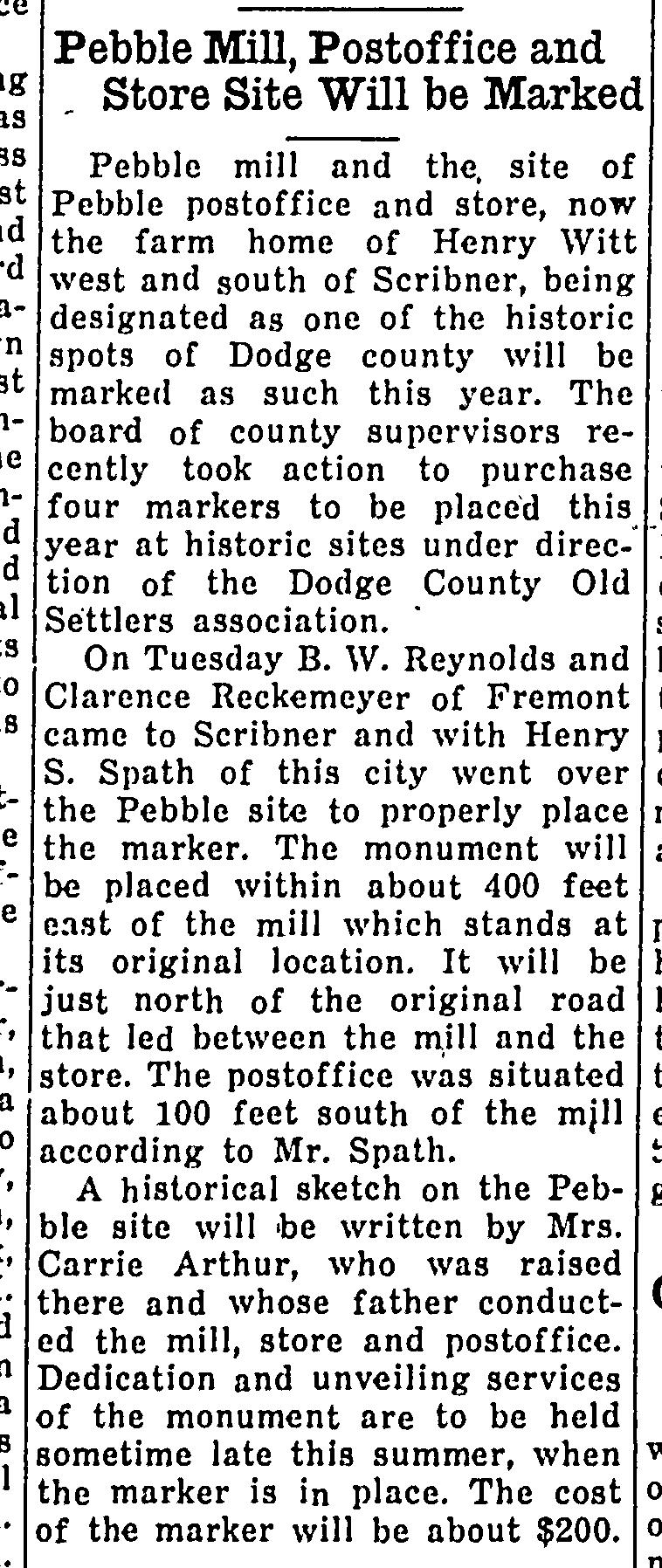
By May 1930, residents were planning to mark Pebble as a historic place. The Scribner Rustler described the site as Henry Witt’s farm southwest of Scribner and reported that the mill still stood in its original location. County supervisors had approved four historic markers under the Dodge County Old Settlers association’s direction.[6]
The proposed Pebble marker was to stand about 400 feet east of the mill, north of the old road between the mill and store. Henry S. Spath placed the former post office about 100 feet south of the mill. Carrie Arthur, who had grown up there and whose father had operated the mill, store and post office, was to prepare its history. A late-summer dedication and a marker costing about $200 were planned. These are the newspaper’s 1930 landmarks and plans; they do not establish the marker’s present location or public access.[6]
Pebble's story is larger than the word “defunct.” A mill kept working, a congregation continued elsewhere, and records survived. Looking for a lost town can lead us to the community it helped build.