Someone signing a letter “One Who Knows” wanted Hooper’s cemetery troubles made public. According to the town’s 1976 centennial history, the anonymous writer complained to the Fremont Herald in February 1882 about families who had bought cemetery lots, improved them and then discovered a problem with their titles. The complaint left behind a troubling question about the security of a burial place.[1]
What the letter was said to allege
The centennial compilers describe an unnamed man who arrived in the Hooper area around 1872 and later acquired a farmer’s property through a mortgage. That land, the account says, included the cemetery. Families who already held deeds expected to remain in possession of their lots, but allegedly found their legal titles defective.[1]
The new owner was accused of demanding payment for the whole cemetery at $100 an acre before making those titles good. The book preserves the accusation and the writer’s anger; it does not identify the owner or explain how the matter ended.[1]
This remains an allegation reported by the 1976 book. The original letter, the relevant deeds and a record of the outcome have not been verified. We therefore cannot name the man, establish that the complaint was accurate or say what settlement followed. The unanswered historical question concerns what happened then; it is not a claim about the cemetery’s present title.
Planting trees and collecting names
The same page preserves a different side of the cemetery’s history: the community’s continuing care. In April 1894, it reports, 115 evergreen and shade trees were planted. The brief item records a substantial planting effort without naming the trees’ donors or the people who put them into the ground.[1]
In February 1897, the Hooper Cemetery Association asked residents for help making a burial record. Secretary T. W. Lyman sought each deceased person’s name and age, burial date, cause of death and lot number. The request also asked where and when the person was born and when they had come to the area.[1]
Those questions reached beyond a name on a stone. Birthplaces and arrival dates could connect the cemetery to the history of migration into Hooper; lot numbers could connect a written account to a particular place. The request shows an effort to gather such information, though the book does not tell us how many families responded or where the resulting record went.
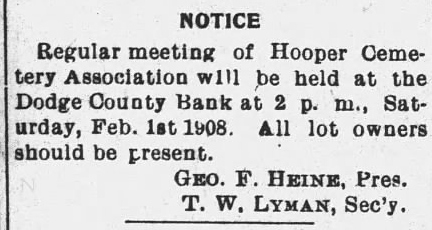
An original newspaper notice supplies another dated record of the association at work. On January 30, 1908, the Hooper Sentinel advertised a meeting at Dodge County Bank for 2 p.m. on February 1 and asked all lot owners to attend. It was signed by Geo. F. Heine as president and T. W. Lyman as secretary. The notice independently places Lyman in that office eleven years after the record-gathering request preserved by the centennial book.[3]
A path to the cemetery
Another dated note, May 22, 1913, reports $612 collected for a cement sidewalk to the cemetery. Alongside the tree planting and burial-record request, it gives us three concrete forms of community involvement: improving the grounds, preserving information and providing a route to reach them.[1]
For readers tracing a family, Tamara Bentz’s online collection offers photographs and transcriptions of selected Hooper Cemetery markers. Its limited scope matters: an absent name does not demonstrate that someone was never buried there. It is a starting point to compare with family documents and cemetery records.[2]
Do you have an early cemetery deed, an association record, a photograph showing the old sidewalk or a clipping about the 1882 dispute? Please share a copy with Celebrate Hooper, including any date or family identification that came with it. Even a modest piece of paper may help answer a question the centennial book left open.