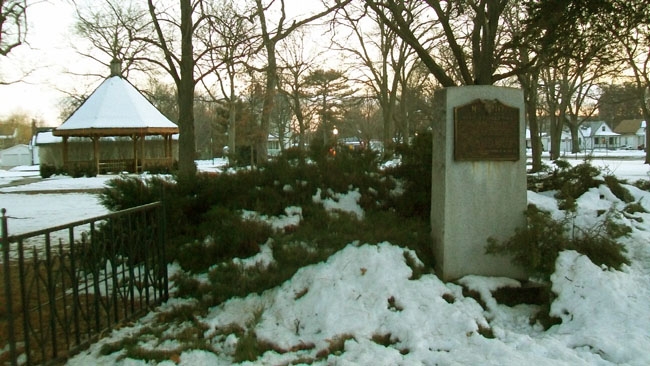
Fremont’s Barnard Park has a past that needs no ghost story to make it striking: the ground was once Green Grove Cemetery. The graves were moved as the city developed, and the former burial ground became a neighborhood park. That change is documented. The stories about what—or who—might have remained belong to a later, less certain history.[1]
What the cemetery records say
The clearest contemporary evidence appeared in the Fremont Tribune on October 1, 1884. A published cemetery-association resolution offered the Green Grove block to the city for permanent use as a public park. It described the cemetery as empty of graves, or nearly empty, and proposed removing any that remained. The payment terms called for four annual installments of $300, beginning in 1885.[2]
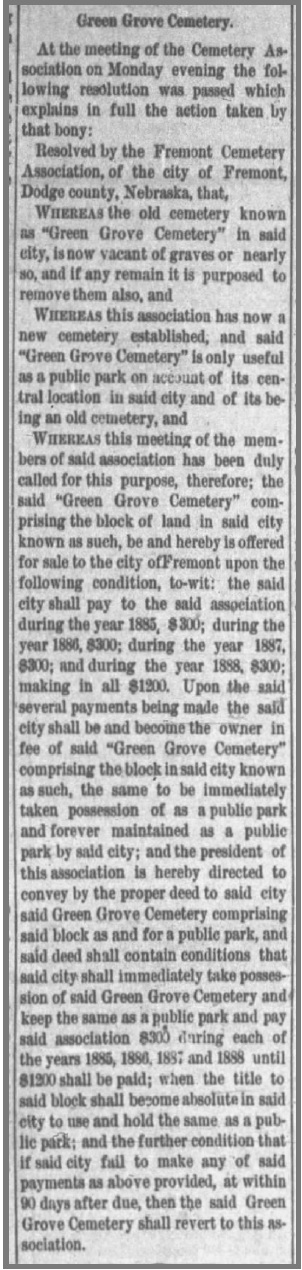
That wording preserves an important uncertainty. The association was planning a park and acknowledging the possibility of remaining graves. The resolution alone does not tell us whether every removal was subsequently completed, much less establish a modern count of bodies beneath the park.
A 1962 Tribune anniversary history describes an earlier move from flood-threatened Pine Ridge Cemetery to Green Grove, followed by relocation to the larger Ridge Cemetery in 1878. It dates Ridge’s dedication to June 21 of that year. The National Register history places the park’s naming for town surveyor E. H. Barnard in the mid-1880s.[3][1]
The park’s later everyday life is visible in a 1925 photograph of its picnic pavilion preserved by the Dodge County Historical Society. The library catalog identifies photographer Leonard B. Skoglund and a view from Sixth and Clarkson streets, with the pavilion, plantings and brick-paved streets. It offers another way to picture the public space that succeeded the cemetery.[7]
How the haunting enters the record
In a later Tribune report, journalist Jeff Forward interviewed parks employee Nate Schwanke, who remembered hearing ghost stories about Barnard Park while growing up. Forward also interviewed Dave Christensen of the Nickerson-based group Phantasm Paranormal about its investigations.[4]
Christensen linked the alleged haunting to a claim that seven bodies had not been moved. That number is an investigator’s assertion in the report, rather than a count established by a burial register or the 1884 resolution. The article is valuable evidence of the park’s reputation and the people discussing it.[4]
A marker is not the campsite
Another detail calls for care. Barnard Park contains a Mormon Trail marker, but the National Park Service’s historic resource study locates the Liberty Pole Camp staging ground southwest of Fremont, near the Platte River. The park’s marker commemorates that place. Its presence does not establish that a particular emigrant camped or was buried on the park block.[5]
There is also room for ordinary experience in this history. In 2007, Tribune reporter Don Bowen interviewed caretakers at Ridge and the Catholic cemetery who reported no supernatural encounters. Their work involved familiar night sounds, wildlife and occasional vandalism. Although the article mentions Barnard Park’s cemetery predecessor, it does not report a Barnard haunting.[6]
A family burial record, an early park photograph or a dated clipping could help tell more of the story. If you have one, please share a copy with Celebrate Hooper, including any names, dates or source information that came with it.